
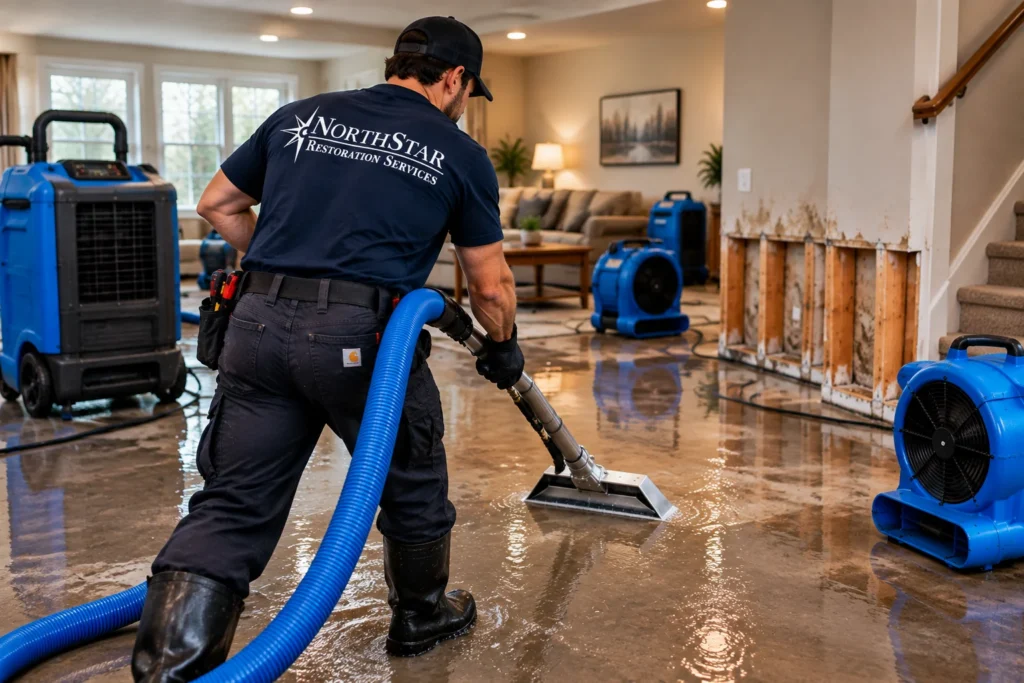
If water is entering your home or business, move away from electrical hazards, stop the source only if it is safe, and call NorthStar Restoration Services at (715) 302-0529. Our IICRC-certified team provides 24/7 Water Removal Services across Wausau and Central Wisconsin. We extract visible water, locate moisture that has spread into materials, build a controlled drying plan, document progress, and coordinate repairs when needed.
NorthStar is licensed and insured, has completed more than 500 projects, and has earned 300+ customer reviews. Our goal is to reach emergency sites within 60 minutes; actual arrival time depends on weather, road conditions, distance, crew availability, and safe site access.
Water entering the building now? Call (715) 302-0529 or request an emergency response. Our emergency water extraction team is on call day and night for homes, businesses, rental properties, and managed facilities.
What to Do Immediately After Water Damage
- building and call 911 if you smell gas, see a sagging ceiling, suspect structural instability, or believe someone may be in danger.
- Avoid electrical hazards. Never step into standing water near outlets, appliances, power strips, or an electrical panel. Do not switch power on or off while standing in water. Call the fire department or a qualified electrician if the shutoff cannot be reached from a dry, safe location.
- Stop the source only when safe. Close an accessible fixture valve or the main water valve if you can reach it without entering the wet area. Contact a plumber, appliance technician, roofer, septic professional, or utility when the source requires repair.
- Do not assume the water is clean. Water from a sewer, toilet containing waste, river, or outdoor flood can contain biological or chemical contaminants. Avoid contact and tell the restoration team where the water came from. For wastewater, use NorthStar’s sewage response page.
- Document from a safe location. Photograph the source and affected rooms without walking through water. Notify your insurer promptly and ask what emergency actions and records the policy requires.
- Call for professional assessment. Visible puddles can be removed while moisture remains beneath flooring, behind trim, inside wall cavities, or in insulation. A restoration inspection establishes the source, water category, affected materials, and safe next step.
The CDC warns never to operate electrical tools or switch power while standing in water. The EPA recommends drying water-damaged areas and items within 24–48 hours to reduce the chance of mold growth. That is a drying goal—not a reason to wait before calling.
Commercial water damage restoration
What Water Removal Services Include
Every loss is different, so the scope follows the source, amount of water, affected materials, contamination level, and time since the event. Recommended work may include:
- Emergency assessment, safety controls, and source coordination
- standing water removal with pumps or extraction equipment selected for the site
- Detailed inspection of rooms, floors, walls, ceilings, crawl spaces, and contents
- Protection or relocation of salvageable belongings
- Controlled removal of materials that cannot be reliably dried or cleaned
- Equipment placement, humidity control, and recorded drying measurements
- Cleaning appropriate to the water category and affected surfaces
- Documentation for the property owner and insurer
- Repair or reconstruction after mitigation is complete
The objective of professional water damage cleanup is not simply to make the surface look dry. It is to stabilize the property, reduce preventable secondary damage, and establish—with measurements—when retained materials have reached an appropriate drying goal.
Water Removal, Mitigation, Drying, and Restoration: What Is the Difference?
- Extraction removes bulk liquid water with pumps, vacuums, or other professional equipment.
- Water mitigation limits additional damage through source control, extraction, containment, contents protection, selective material removal, and drying.
- Drying manages moisture remaining in air and building materials using air movement, dehumidification, temperature control, and repeated measurements.
- Restoration repairs or replaces damaged finishes and structural components after the property is stabilized.
These stages overlap, but they are not interchangeable. Removing a puddle does not prove that subflooring, wall cavities, insulation, or trim is dry. NorthStar’s emergency restoration team can coordinate the full path from initial extraction through repairs.
Common Water Losses We Handle
Plumbing and Pipe Failures
Frozen lines, failed supply hoses, leaking fittings, and broken plumbing can release a large amount of water quickly. Our burst pipe cleanup response focuses on stopping ongoing damage, extracting water, checking connected rooms, and establishing a drying plan while a plumber addresses the failed component.
Basement and Sump-Pump Events
Heavy rain, foundation seepage, drain problems, and pump failure can affect concrete, finished walls, flooring, stored contents, and mechanical systems. NorthStar provides flooded basement cleanup and sump pump failure cleanup based on the water source and contamination risk. Outdoor floodwater or sewage requires different controls from a clean supply-line loss.
Appliance and Fixture Leaks
Dishwashers, washing machines, refrigerators, water heaters, toilets, tubs, and sinks can leak beneath cabinets or flooring before the damage is obvious. Our appliance leak cleanup assessment checks the visible area and likely migration paths rather than treating only the surface.
Storm and Roof Intrusion
Wind-driven rain, damaged roofing, ice dams, and overwhelmed drainage systems can wet ceilings, insulation, wall assemblies, and floors. Temporary source protection may need to happen before extraction and flood cleanup can progress. NorthStar can coordinate the relevant emergency and repair phases.
Our Eight-Step Extraction and Drying Process
1. Emergency Call and Triage
We ask where the water is coming from, when it started, which areas are affected, whether electricity or structural damage may be involved, and what actions have already been taken. This helps the team prepare the right response and identify conditions that require another emergency trade.
2. Safety and Source Control
On arrival, the crew confirms safe access and evaluates electrical, structural, slip, contamination, and occupant risks. We identify the apparent source and coordinate with the appropriate plumber, roofer, septic contractor, electrician, appliance technician, or utility when source repair is outside the restoration scope.
3. Inspection and Moisture Survey
Visual findings are combined with moisture meters and other diagnostic tools. moisture mapping records where water has traveled and which materials require monitoring. infrared thermal imaging may help identify temperature patterns that warrant further testing, but a thermal image alone does not confirm moisture; readings must be interpreted and verified with appropriate instruments.
4. Bulk Water Extraction
Professional pumps and extraction tools remove accessible liquid water. Faster removal reduces the amount that building materials can absorb and shortens the load placed on drying equipment. The crew may perform multiple extraction passes where carpet or other retained materials are involved.
5. Contents and Material Evaluation
The team identifies belongings and building components that can be protected, moved, cleaned, or dried. contents drying may be completed on site or through another controlled process depending on the item, water category, material, value, condition, and exposure time. Items that cannot be safely or economically restored are documented before disposal when conditions and insurer instructions allow.
6. Targeted Salvage and Removal Decisions
Not every wet material must automatically be discarded, and not every material can be saved. hardwood floor drying or cabinet drying may be possible when the water source, construction, finish, exposure time, and condition support it. Swelling, delamination, contamination, trapped moisture, or mold may change the recommendation. NorthStar explains the basis for removal or salvage decisions before proceeding when emergency conditions permit.
7. Controlled Drying and Monitoring
After extraction, the crew positions air movers, dehumidifiers, and other equipment according to the site conditions. The structural drying plan is adjusted as readings change. Daily or scheduled measurements help show whether retained materials are progressing toward the documented goal; appearance and touch are not reliable completion tests.
8. Completion Review and Repairs
When drying goals are reached, the team records final conditions, removes equipment, and reviews remaining work with you. If drywall, flooring, trim, cabinetry, or other components require rebuilding, NorthStar can coordinate water damage repair and the final walkthrough.
Commercial water damage restoration
Water Category Changes the Response
Restoration professionals commonly evaluate the water source and contamination level before choosing cleaning, drying, and material-handling procedures:
- Category 1 begins from a sanitary source, such as a clean supply line. It can deteriorate after contact with materials or contaminants and as time passes.
- Category 2 contains significant contamination and may come from certain appliance discharges or other sources depending on conditions.
- Category 3 is grossly contaminated and can include sewage, rising outdoor floodwater, or other highly contaminated sources.
The category cannot be decided by color alone. Source, time, temperature, affected materials, and site conditions matter. Do not use household fans to circulate air from an area that may contain sewage or contaminated floodwater.
Commercial water damage restoration
Residential and Commercial Response
Residential water extraction may involve a single room, finished basement, attic, crawl space, or several levels of a home. We explain access, contents handling, equipment noise, safety boundaries, and when affected spaces may be used. Homeowners can also review our residential restoration service.
Commercial water extraction adds business-continuity priorities such as occupants, tenants, inventory, equipment, operating hours, accessibility, and phased work. We coordinate with the authorized facility representative and other trades while documenting the affected areas. See NorthStar’s commercial extraction and drying service or create a Priority Response Emergency Plan before a loss occurs.
What Determines Cost and Timeline?
No responsible estimate can be based on room size alone. Cost and duration can change with:
- The source, category, and volume of water
- The number of rooms and levels affected
- Materials involved and how deeply water migrated
- Time between the loss and professional response
- Access to crawl spaces, wall cavities, ceilings, or built-ins
- Equipment type, quantity, monitoring time, and power availability
- Contents handling, cleaning, storage, or disposal needs
- Required source repairs, demolition, permits, or reconstruction
- After-hours conditions and site-safety requirements
After inspection, NorthStar can explain the immediate mitigation scope, known cost drivers, and which items remain uncertain. A written estimate may change if concealed damage is discovered, so any revision should be documented and discussed.
NorthStar Restoration Services
Advanced Methods
NorthStar Restoration Services uses cutting-edge techniques. Our team finds hidden water quickly. We restore homes safely and efficiently. Count on experts for complete property care.
Insurance Documentation and Communication
Coverage depends on the policy, cause, timing, exclusions, deductibles, and endorsements. A sudden accidental plumbing loss may be treated differently from long-term seepage, maintenance issues, sewer backup, or natural flooding. Your insurer—not the restoration contractor—interprets the policy and decides coverage.
NorthStar can provide insurance claim documentation such as photographs, affected-area notes, moisture readings, equipment records, and an itemized scope. We can communicate with the adjuster about work performed without promising approval, payment, or “maximum coverage.” Keep receipts and avoid discarding items until they are documented or safety conditions require removal.
Why Wausau Property Owners Choose NorthStar
- Local 24/7 dispatch: Wausau-based emergency support for homes and businesses across Central Wisconsin.
- Verified credentials: IICRC certified, licensed, and insured.
- Measured drying: Professional extraction, dehumidification, and progress readings instead of visual guesswork.
- One accountable team: Mitigation, repair coordination, and final walkthrough through one restoration partner.
- Established proof: More than 500 completed projects and 300+ customer reviews. View recent projects and customer feedback.
- Clear communication: Site-specific scope, progress updates, documentation, and realistic coverage language.
When you choose a local water restoration company, verify its location, phone number, credentials, response terms, and recent project evidence. NorthStar serves the region from 4900 Stewart Avenue, Wausau, WI 54401. Property owners can also use our water-emergency preparedness guide to plan shutoff access, documentation, and emergency contacts in advance.
Frequently Asked Questions!
Move people and pets away from the affected area, avoid electrical hazards, stop the source only if it can be reached safely, and call a restoration professional. Photograph conditions from a dry location and notify your insurer. Call 911 for an immediate life-safety, gas, fire, or structural emergency.
Immediately after people are safe and the source can be controlled. The EPA’s 24–48-hour guidance is a goal for drying wet materials, not a waiting period. Prompt extraction and assessment reduce the time water has to migrate into additional materials.
Bulk extraction may take hours, while drying often takes several days; complex losses and reconstruction can take longer. Source, water category, materials, temperature, humidity, access, and the extent of migration all affect the schedule. NorthStar updates the timeline as measured conditions change.
Only if electricity has been declared safe and the water is known to be from a sanitary source. Do not use electrical equipment while standing in water, and do not circulate air from an area that may contain sewage or contaminated floodwater. When the source or safety is uncertain, wait for professional assessment.
Technicians compare moisture readings in affected materials with appropriate drying goals and unaffected reference areas when available. They also consider humidity, equipment performance, material type, and measurement trends. A surface that feels dry is not enough evidence by itself.
Sometimes. Salvage depends on the water category, material construction, finish, exposure time, swelling, delamination, trapped moisture, and whether drying can begin promptly. The team should explain why a material is recommended for drying, removal, or further evaluation.
It may, depending on the policy and cause. Sudden accidental discharge is often handled differently from long-term leaks, maintenance problems, sewer backup, and natural flooding. Contact your insurer promptly and ask about deductibles, exclusions, endorsements, documentation, and emergency mitigation requirements.
Yes. NorthStar serves commercial buildings, rentals, multifamily properties, offices, retail spaces, and other facilities. We coordinate with the authorized representative on access, occupants, work zones, documentation, operating priorities, and repair phases.
If visible or suspected growth is discovered, the team can reassess containment and scope. NorthStar can explain whether professional mold remediation or additional evaluation is appropriate. Mold work should be documented separately when it falls outside the original water-loss scope.
Proudly Serving Central Wisconsin
Call for Water Removal Services in Wausau
Do not wait for standing water to disappear on its own. Protect people, avoid electrical hazards, stop the source only when safe, and call NorthStar Restoration Services. We are available 24/7 to assess the loss, begin the appropriate extraction and drying process, and explain the next steps.
Call (715) 302-0529 now or send NorthStar your project details.
Response times vary with distance, weather, road conditions, crew availability, and safe access. Safety and insurance information on this page is general and does not replace advice from emergency services, electricians, plumbers, public-health authorities, medical professionals, or your insurer.