
NorthStar Restoration Services
Commercial Water Damage Restoration in Wausau, WI
When water enters an office, retail space, healthcare facility, school, apartment building, restaurant, warehouse, or industrial property, the priority is to protect people, stop the source when it is safe to do so, remove water, document affected areas, and begin controlled drying. NorthStar Restoration Services provides Commercial Water Damage Restoration for businesses in Wausau and Central Wisconsin with 24-hour emergency availability. NorthStar’s current site also identifies the company as IICRC Certified and states that its team has more than 100 years of combined restoration experience.
For a business owner searching for commercial water damage restoration near me, the right provider should be able to explain what is wet, how far moisture has traveled, what can be restored, what must be removed, how the drying plan will be monitored, and what has to happen before normal operations can resume.
The ANSI/IICRC S500 standard specifically covers professional water-damage restoration procedures and precautions for residential, commercial, and institutional buildings.
When Professional Commercial Restoration Is Needed
Commercial losses can result from burst or frozen pipes, roof leaks, appliance or sprinkler failures, plumbing backups, storm intrusion, groundwater, or water associated with fire suppression. Emergency commercial water damage requires a different response from routine building maintenance because affected materials and concealed spaces need to be assessed systematically.
A complete restoration scope may include commercial water extraction, water mitigation, structural drying, commercial dehumidification, selective demolition, cleaning, contents handling, repairs, and final documentation. The exact sequence should be based on the source, materials affected, extent of saturation, contamination concerns, and site conditions. IICRC’s S500 provides the industry’s procedural framework for professional water-loss work.
Water Removal Is Only the First Phase
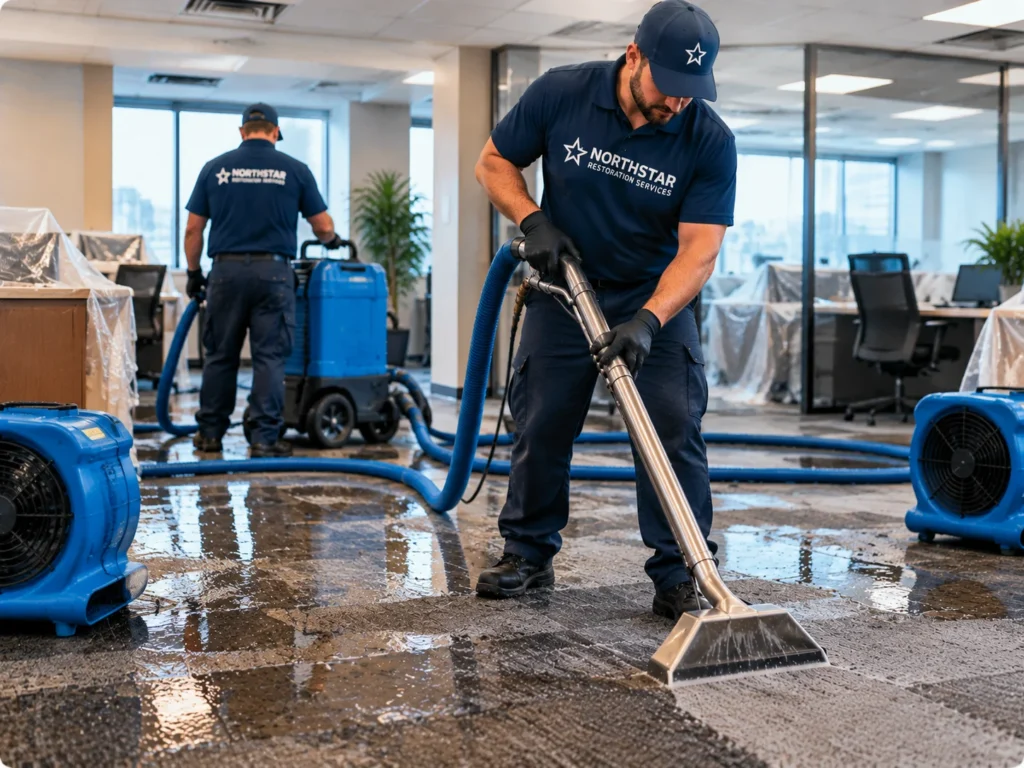
Standing water needs to be removed quickly, but extraction alone does not mean a building is dry. A professional Commercial Water Damage Restoration project continues after bulk water is removed by evaluating moisture in affected materials and tracking progress toward drying goals.
NorthStar already has a dedicated commercial water removal service for the urgent extraction phase. That page should own the immediate standing-water intent, while this page should own the broader recovery process: drying, material decisions, contents, documentation, repairs, reconstruction, and return to use.
Our Commercial Water-Damage Response Process
1. Emergency Contact and Site Safety
The first call should establish what happened, whether the source is still active, what parts of the building are affected, whether utilities or other hazards are involved, and which areas are operationally critical.
The project team should coordinate access with the owner, facility manager, property manager, security contact, or another designated representative before restoration activities begin.
2. Inspection and Moisture Assessment
Visible water does not necessarily show the entire affected area. Moisture mapping can help document conditions in materials and guide equipment placement, removal decisions, and drying goals.
A useful assessment can include moisture meters, thermal imaging where appropriate, visual inspection, material evaluation, and photographs. NorthStar’s current page states that it uses thermal imaging and moisture meters during inspection.
3. Remove Standing Water
Emergency water removal reduces the volume of liquid water that can continue affecting building materials.
Pumps, extractors, and other equipment should be selected according to the depth of water, accessibility, affected materials, and loss conditions. NorthStar’s dedicated commercial extraction page currently describes truck-mounted units, portable extractors, submersible pumps, thermal imaging, moisture meters, air movers, and dehumidification equipment.
Extraction should then be followed by evaluation of moisture remaining beneath or behind visible surfaces.
4. Establish the Drying Plan
Air movement, temperature, humidity control, material characteristics, and building conditions all influence drying.
A controlled plan should establish drying goals and be adjusted as measurements show how affected materials are responding. The IICRC S500 standard defines procedures and precautions for professional water restoration rather than treating drying as a simple “set up fans and wait” process.
5. Monitor and Document Progress
Drying equipment should not simply be installed and removed according to an arbitrary timetable.
Technicians should record relevant conditions and evaluate whether materials are progressing toward the established drying goals. Consistent measurements, equipment records, photographs, and project notes can also make the scope easier for an owner, property manager, adjuster, or insurer to understand.
6. Clean, Remove, or Restore Affected Materials
Some materials may be restorable. Others may require removal because of contamination, physical deterioration, swelling, delamination, loss of integrity, or another condition.
For flood damage cleanup, the source and condition of the water should influence the handling plan. BELFOR’s current commercial process similarly identifies amount of damage, degree of contamination, and restoration-versus-replacement cost as key factors in its evaluation.
7. Protect Contents and Business Assets
Contents restoration may involve documenting, moving, cleaning, drying, or storing salvageable property while work on the structure continues.
Depending on the facility, priorities may include:
- Records and files
- Furniture
- Merchandise
- Equipment
- Tools
- Inventory
- Electronics
- Tenant or customer property
Specialty electronics, documents, machinery, or other sensitive property may require evaluation by appropriate specialists.
8. Repair and Return the Property to Use
Once affected areas meet the appropriate drying and cleaning criteria, water damage repair may include drywall, insulation, flooring, trim, ceilings, cabinetry, paint, or other building components.
The project should finish with a clear understanding of:
- What was restored
- What was replaced
- What remains outside the scope
- What warranties apply
- What documentation is available
- Whether follow-up work remains
NorthStar’s current page states that it provides reconstruction after mitigation, including drywall, flooring, cabinetry, painting, and coordinated trades.
Different Businesses Require Different Recovery Plans
A retail store may need to preserve customer access and protect merchandise. An office may prioritize workstations, records, conference rooms, network areas, and employee access. A healthcare or dental property may require additional operational controls.
A hotel may need to isolate affected rooms while protecting guest spaces. An industrial property may contain machinery, process equipment, restricted areas, or high-value inventory. SERVPRO’s current commercial page makes this operational point clearly by emphasizing minimizing business disruption alongside extraction, cleanup, repair, and restoration.
For business water damage, the restoration plan should therefore consider both the physical building and the operation taking place inside it. This is also why business interruption belongs in the initial planning discussion. The objective should not be to promise zero downtime. It should be to sequence work intelligently, isolate affected areas when feasible, and coordinate restoration around business priorities.
Commercial Flood and Storm Damage
Commercial flood restoration can involve more than pumping water from a floor. Exterior intrusion may affect:
- Wall assemblies
- Flooring systems
- Mechanical rooms
- Basements
- Lower-level storage
- Inventory
- Furnishings
- Electrical areas
- Building contents
The source should be documented along with the materials affected and any conditions requiring additional cleaning, removal, or safety controls. When the loss also involves roof, exterior, or storm-related property damage, NorthStar’s storm damage cleanup service is a natural supporting internal link.
How Quickly Should Wet Materials Be Dried?
There is no credible universal promise that every commercial structure will be dry in the same number of hours. Material type, volume of water, temperature, humidity, accessibility, construction, and the source of the loss all affect drying.
EPA guidance states that wet or damp materials should generally be dried within 24–48 hours after a leak or spill when possible, because prompt drying reduces the likelihood of mold growth.
That does not mean every material can always be saved within 48 hours, nor should NorthStar state that mold automatically begins growing at a precise hour. If a separate mold problem is identified, link users to NorthStar’s mold damage restoration service rather than turning this water page into a duplicate mold page.
Commercial water damage restoration
Insurance and Project Documentation
A large commercial loss can generate:
- Photographs
- Moisture readings
- Equipment logs
- Demolition decisions
- Repair estimates
- Invoices
- Material inventories
- Contents records
- Communications with the carrier
Insurance claim documentation should therefore be organized from the beginning instead of reconstructed at the end.
SERVPRO prominently presents an easier insurance-claim process as part of its commercial offer, while NorthStar’s current page says its team works with insurance carriers, documents damage, and provides estimates.
Coverage decisions remain with the insurer and policy. A restoration contractor can document conditions and work performed, but the page should not promise that a specific claim will be covered.
What Determines Commercial Restoration Cost?
The cost of Commercial Water Damage Restoration depends on the actual loss. Major variables can include:
- Size of the affected area
- Amount and spread of water
- Source and contamination concerns
- Materials involved
- Accessibility
- Extraction requirements
- Drying equipment
- Monitoring requirements
- Contents handling
- Demolition and disposal
- Repairs and reconstruction
- After-hours work
- Restricted access
- Specialty equipment or subcontractors
BELFOR’s current commercial page similarly considers damage severity, contamination, and restoration-versus-replacement decisions when determining its response plan. A useful commercial estimate should separate immediate mitigation from later reconstruction so the property owner understands what each phase includes.
Why Choose NorthStar for a Commercial Loss?
When comparing a commercial restoration company, look for verifiable training, a clearly documented process, moisture monitoring, transparent scope, communication protocols, local response capability, and evidence from real projects.
NorthStar’s current page states that the company is IICRC Certified, provides 24-hour emergency response, and has more than 100 years of combined industry experience. Those trust signals become considerably stronger when paired with first-party project evidence such as:
- Technician name
- Verified credential
- Real equipment
- Actual moisture readings
- Before-and-after photographs
- Facility type
- Loss cause
- Drying duration
- Materials saved or removed
- Reconstruction outcome
For broader business-oriented restoration information, link naturally to NorthStar’s commercial benefits and services page.
Prepare Before the Next Water Emergency
Facility teams can reduce confusion during a loss by documenting:
- Main water shutoffs
- Utility controls
- Emergency contacts
- Building access instructions
- Server and electrical rooms
- High-value inventory
- Restricted areas
- Insurance contacts
- Building plans
- After-hours procedures
- Key decision-makers
NorthStar’s PREP Planning service is the strongest internal link for businesses that want to organize emergency-response information before a property loss occurs.
Emergency Water Damage Restoration
Schedule Commercial Water Damage Restoration
If water is actively affecting your Wausau-area commercial property, contact NorthStar for an assessment and response plan. The initial response should establish: What areas are affected? Is the source controlled? What needs immediate extraction? Which materials require moisture assessment? What operational areas are most critical? What documentation is required? What will happen after the building is dry? For active standing water, use NorthStar's commercial water removal service. For general inquiries and planning, use the NorthStar contact page.
Need Emergency Help?
Contact NorthStar now and provide:
- Business/facility type
- Property address
- Source of water if known
- Approximate affected area
- Whether water is still entering
- Whether utilities are affected
- Critical operational areas
- Access/contact information
A clear first call helps the responding team understand the loss before arrival.
Frequently Asked Questions
Water removal focuses on extracting standing or bulk water.
Full restoration continues with moisture assessment, drying, cleaning, material decisions, contents, repair, reconstruction, and documentation as required. NorthStar currently maintains separate pages for these two intents, so keeping that distinction clear is important for both customers and search engines.
There is no universal timeline.
Duration depends on the size and complexity of the loss, building materials, accessibility, contamination concerns, drying progress, demolition, reconstruction, and operational restrictions. Professional water-loss work should be based on the actual structure and conditions rather than one fixed timeframe.
Sometimes.
The answer depends on safety, the source of water, affected utilities, contamination, equipment placement, noise, access, and whether the work area can be separated adequately from normal operations.
Coverage depends on the policy, cause of loss, exclusions, limits, and insurer’s determination.
The contractor can document conditions, work, equipment, and repair scope, but should not guarantee coverage.
Professional decisions should rely on documented measurements and appropriate drying criteria rather than appearance alone.
The ANSI/IICRC S500 is the principal industry standard covering procedures and precautions for professional water-damage restoration work.
No.
The decision depends on material condition, contamination, physical damage, construction, accessibility, and whether the material can be appropriately dried and restored.
EPA guidance for commercial buildings likewise differentiates among materials and notes that some wet materials may be dried while others may require removal depending on their condition.
If it is safe to do so, isolate or stop the source, keep people away from hazardous areas, preserve access for emergency responders, and prepare building/contact information.
Do not enter areas where electrical, structural, sewage, chemical, or other serious hazards may exist.
NorthStar’s current commercial page states that its scope can continue from mitigation into reconstruction, including drywall, flooring, cabinetry, painting, and coordination of trades. Confirm the specific reconstruction scope in the written project estimate.
Proudly Serving Central Wisconsin
Looking for something else?
Water Damage Cleanup
Residential Water Damage Restoration
Flooding & Water Damage Repair
Contact NorthStar Restoration Services Today
Don’t wait — protect your property now. Call (866) 439-9318 for 24/7 Emergency Restoration
📍` 4900 Stewart Ave, Wausau, WI 54401 NorthStar Restoration Services — Your local, trusted restoration experts.