

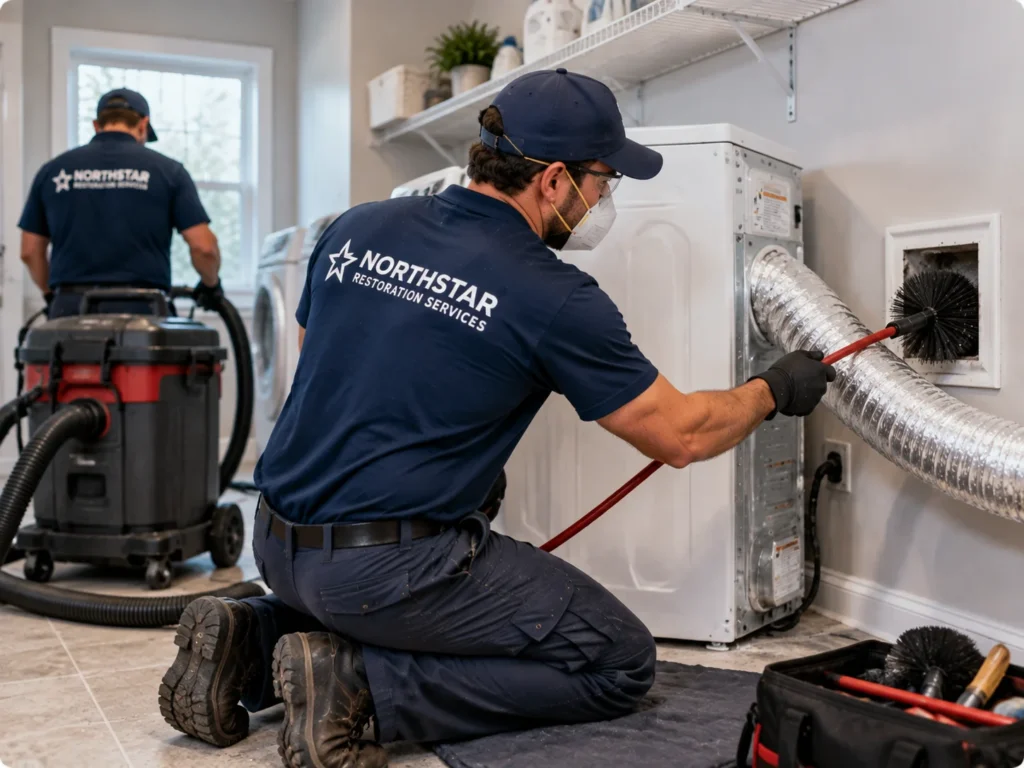
NorthStar Restoration Services provides Dryer Vent Cleaning for homeowners and businesses in Wausau and across Central Wisconsin. The purpose is to inspect the dryer exhaust route, remove accumulated lint and debris, check the exterior termination, and verify that the vent is exhausting properly after service.
This is primarily a fire-safety and appliance-maintenance service—not an indoor-air-quality treatment. The U.S. Fire Administration reports that failure to clean was the leading factor contributing to ignition in 31% of home clothes-dryer fires from 2018–2020. CPSC also advises consumers to keep the exhaust vent unrestricted and clean lint from the vent pipe at least once a year.
NorthStar Restoration Services
When Should You Schedule Dryer Vent Cleaning?
Warning signs can include longer drying cycles, unusually hot clothing or a hot laundry area, a burning or overheated odor, visible lint behind the appliance, weak airflow at the outside termination, or an exterior flap that does not open normally while the dryer is running. CPSC specifically recommends ensuring that the exhaust pipe is not restricted and that the outdoor flap opens during operation.
A clogged dryer vent is not the only possible cause of slow drying, so the system should be inspected rather than diagnosed from one symptom alone. The dryer itself, transition connection, vent length, bends, termination cap, and appliance condition can all affect performance.
NorthStar Restoration Services
What Our Dryer Vent Cleaning Process Should Cover
1. Inspect the Dryer-to-Exterior Route
A professional dryer vent inspection should identify the path from the appliance connection to the outdoor termination and look for crushed sections, loose connections, excessive bends, visible lint, damaged ducting, or an obstructed exterior hood.
Cal Duct’s competitor page makes the full dryer-to-exterior inspection part of its defined scope, while Ductech also checks the vent route for restrictions and damaged sections.
2. Establish a Baseline
Where appropriate, an airflow test can provide a useful pre-service reference.
The objective is not to promise a specific number for every home. It is to establish whether exhaust appears restricted and, where practical, compare conditions after the vent has been serviced.
Ductech uses pre- and post-service airflow checking as one of its strongest proof points.
3. Loosen Accumulated Lint
The cleaning method should match the vent material, length, access, and configuration.
Where compatible with the system, rotary brush cleaning can agitate compacted material so that it can be collected and removed from the run. Cal Duct explicitly describes this method as part of its full-run process.
NorthStar’s current page says its team uses high-pressure air tools and video inspection. Those details can be strong first-party differentiators, but they should remain on the updated page only if they accurately reflect the equipment and procedure NorthStar currently uses on real jobs.
4. Remove Debris Through the Full Run
Effective lint removal should address the exhaust pathway rather than only the lint screen or first few feet behind the appliance.
The vent begins at the dryer connection and terminates outside the building. A professional scope should clearly tell the customer how much of that route will be cleaned and whether any sections cannot be safely accessed.
Cal Duct makes “full run” cleaning a central differentiation point and describes vacuum collection of material loosened from the duct walls.
5. Check the Exterior Termination
Professional exterior vent cleaning should verify that the termination is clear and that the flap or damper can open as intended.
CPSC specifically advises homeowners to make sure the outdoor vent flap opens while the dryer is operating.
This step can also reveal:
- Lint accumulation at the termination
- A stuck flap
- Debris around the hood
- Pest or nesting material
- Damage to the exterior component
- A termination that requires separate repair
6. Reconnect and Verify
After cleaning, the dryer connection should be secured, the work area cleaned, and exhaust operation rechecked.
The goal is to document whether measurable airflow improvement occurred rather than simply telling the customer that the vent is “clean.” A strong NorthStar process page should show actual verification through photos, airflow measurements where used, and a final exterior check.
Why Dryer Vents Become Restricted
Some lint passes the appliance filter and can collect inside the exhaust path over time. Restrictions can also involve:
- Crushed transition material
- Kinked connections
- Long exhaust runs
- Multiple bends
- Damaged duct sections
- Exterior caps that do not open freely
- Bird or pest-related debris
- Poorly configured terminations
The phrase dryer duct cleaning is often used by consumers for the same general service, but the scope should remain clear: this page addresses the clothes-dryer exhaust pathway, not the home’s HVAC supply-and-return system. Similarly, dryer exhaust cleaning focuses on the route carrying heat and moisture from the appliance outdoors.
For HVAC-system concerns, use NorthStar’s Air Duct Cleaning service instead.
Dryer Fire Risk: What the Evidence Actually Supports
Dryer maintenance is a legitimate fire-safety issue, but a contractor should not claim that one cleaning appointment eliminates fire risk.
USFA reports that failure to clean was the leading factor contributing to ignition in 31% of home clothes-dryer fires from 2018–2020.
CPSC also estimates a yearly average of 6,400 clothes-dryer fires in its 2023 consumer guidance and recommends several practical measures: keep the lint filter clean, keep the exhaust pipe unrestricted, make sure the exterior flap opens, and clean lint from the vent pipe at least once a year.
That makes dryer fire prevention an appropriate educational topic when it is framed as risk reduction and maintenance, not a guarantee that a fire cannot happen.
How Often Should the Vent Be Cleaned?
CPSC recommends cleaning lint out of the vent pipe at least once a year. USFA also publishes annual dryer-vent ductwork cleaning as part of its home fire-safety guidance. Actual inspection or maintenance needs may vary based on:
- Laundry volume
- Vent length
- Number of bends
- Roof versus wall termination
- Appliance configuration
- Manufacturer instructions
- Evidence of restriction
NorthStar’s current page gives both an annual recommendation and a broader 6–12 month schedule.
A clearer page recommendation is:
Use annual vent cleaning as the baseline consumer-safety guidance, then adjust inspection or service frequency when the actual system configuration, usage, or manufacturer instructions justify it.
This is more defensible than telling every customer to schedule at six-month intervals.
DIY vs. Pro Cleaning
You should clean your vent for safety and total efficiency. You may wonder about diy dryer vent cleaning versus hiring experts. Let’s compare both options to find the best choice for you. Professionals use the best dryer vent cleaning near me methods.
Pros and Cons
DIY cleaning has pros and cons:
Pros
Cost-effective
Easy for minor cleanups
Immediate action
Cons
Time-consuming
Not thorough
Risks to safety
Professional cleaning a dryer vent also has pros & cons:
Pros
Complete and effective
Maintains safety
Saves time
Cons
Higher starter cost
Scheduling needed
What About the Connection Behind the Dryer?
The transition section behind the appliance deserves inspection because crushing, kinking, disconnection, or inappropriate material can restrict exhaust.
USFA guidance recommends inspecting the venting behind the appliance for damaged, crushed, or restricted sections and has historically advised rigid, non-ribbed metal duct rather than coiled-wire foil or plastic venting.
If the technician discovers damaged or unsuitable components, dryer vent installation or repair should be presented as a separate scope unless replacement is already included in NorthStar’s quoted service.
The customer should be told:
- What is damaged
- Why replacement is recommended
- Which component will be replaced
- Which material will be installed
- Whether the price is included or additional
Do not automatically copy Ductech’s component-upgrade offer simply because its competitor page promotes UL-2158A semi-rigid connectors. NorthStar should publish only products and installation practices it actually uses.
Residential and Commercial Applications
A local dryer vent service can support single-family homes, condos, apartments, laundries, and selected commercial properties, but access and vent configuration vary significantly. Multi-unit buildings may involve:
- Stacked appliances
- Confined laundry closets
- Long vertical runs
- Roof terminations
- Restricted service access
- Property-management coordination
- Multiple appliances
The estimate should clearly state which appliance and exhaust route are included and whether exterior or roof access is required.
Ductech’s competitor page specifically separates standard, stacked-dryer, and appliance-plus-vent service options, demonstrating the value of making scope differences obvious before booking.
Will Cleaning Reduce Drying Time?
It can when exhaust restriction is contributing to longer cycles. CPSC’s historical technical work found that lint buildup and restricted airflow can elevate dryer temperatures, while current CPSC guidance continues to emphasize keeping exhaust pathways unrestricted.
However, long drying time can also result from:
- Appliance malfunction
- Heating-element issues
- Sensor problems
- Oversized loads
- Incorrect settings
- Another mechanical problem
NorthStar should therefore avoid guaranteeing that every customer will get a specific percentage reduction in drying time or energy use.
The stronger claim is: If lint or another vent restriction is reducing exhaust flow, removing that restriction can address one cause of poor dryer performance.
Is Dryer-Vent Cleaning an Indoor-Air-Quality Service?
It should not primarily be marketed that way. NorthStar’s current page claims that dryer-vent service significantly improves indoor air quality, lowers allergens, prevents respiratory problems, and helps allergy sufferers breathe more easily.
Those claims should be removed or substantially rewritten.
The dryer exhaust system’s core job is to move heat, moisture, and exhaust from the appliance to the exterior. For this service page, focus on:
- Lint accumulation
- Vent restriction
- Exterior exhaust
- Fire-risk reduction
- Appliance operation
- Maintenance
- Verification
This creates cleaner search intent and stronger trustworthiness.
What Does Professional Service Cost?
Price depends on the vent configuration and project scope. Common cost factors include:
- Vent length
- Number of bends
- Wall versus roof termination
- Dryer accessibility
- Stacked or confined appliances
- Level of lint accumulation
- Safe roof-access requirements
- Damaged transition material
- Repair or replacement needs
Both competitors in the research make pricing more visible: Cal Duct advertises service from $149, while Ductech currently lists a $169 dryer-vent service on its Sunnyvale page. NorthStar can close that conversion gap by publishing a starting price, typical range, or clear pricing factors only if the company can keep the information accurate.
Customers can use NorthStar’s Request an Estimate page for non-emergency service inquiries.
Why Choose NorthStar in Wausau?
NorthStar’s current site identifies the business in Wausau, and the service-page header displays 314+ Google reviews with a 4.8/5 rating.
Those are useful business-level trust signals, but this page can become considerably stronger by adding service-specific first-party evidence:
- Real NorthStar technician
- Technician role and verified training
- Actual cleaning equipment
- Original vent photos
- Before/after exterior-airflow readings where used
- Real Wausau project example
- Vent configuration
- Problem discovered
- Work completed
- Final verification
Review NorthStar’s About Us page and customer reviews and recent projects before scheduling.
NorthStar’s reviews page already contains an actual project entry describing a technician unclogging and cleaning a dryer vent, which is exactly the type of first-party evidence that should be expanded into a case study on this page.
For related educational content, NorthStar also has a dryer-vent and air-duct maintenance article. Before using that article as a major authority-supporting internal link, update its unsupported respiratory-health and universal efficiency claims.
Schedule Dryer Vent Cleaning in Central Wisconsin
If loads are taking longer to dry, the exterior flap is barely opening, lint is collecting around the connection, or the exhaust path has not been serviced in a year, NorthStar can inspect the vent route and define the appropriate scope.
Use the Request an Estimate form and provide:
- Whether the dryer is gas or electric
- Whether it is stacked or freestanding
- Where the exterior termination is located
- Whether the vent exits through a wall or roof
- Whether drying time has changed
- Whether you have noticed lint, excess heat, unusual odor, or weak exterior exhaust
Request a Vent Assessment
A strong professional visit should answer four questions:
Is the exhaust path restricted?
What caused the restriction?
Was the full accessible run serviced?
How was completion verified?
Frequently Asked Questions!
Yes. USFA reports that failure to clean was the leading factor contributing to ignition in 31% of residential clothes-dryer fires from 2018–2020. Cleaning is one component of broader dryer safety, along with correct installation, lint-filter maintenance, unrestricted exhaust, and proper appliance use.
CPSC advises cleaning lint from the vent pipe at least once a year. Your actual interval may need adjustment based on manufacturer instructions, laundry volume, vent length, bends, and termination configuration.
Homeowners should routinely clean the appliance’s lint filter and keep the visible area around the dryer free from lint.
A long, concealed, roof-terminated, damaged, or heavily restricted run may justify professional service when the complete pathway cannot be safely reached with basic household tools.
Yes. CPSC advises confirming that the outdoor vent flap opens while the dryer is operating. The termination should therefore be part of the inspection and cleaning scope when accessible.
It may if restricted exhaust airflow is contributing to longer cycles.
However, slow drying can also result from an appliance or operating issue, so a shorter drying cycle should not be guaranteed before the system is inspected.
Mechanical debris removal should be treated separately from any optional chemical application.
If NorthStar offers an optional treatment, identify the product, its purpose, where it is applied, and why it is needed rather than automatically including a generic “sanitizer.”
A strong process can include before-and-after photographs, exterior-termination inspection, documentation of the serviced route, and post-service airflow verification where appropriate.
Cal Duct and Ductech both make verification and process transparency prominent elements of their current competitor pages.