
NorthStar Restoration Services
Commercial Smoke Damage Cleanup in Wausau, WI
Smoke can affect areas far beyond the room where a fire started. Residue may settle on walls, ceilings, fixtures, equipment, furnishings, inventory, and building systems, while odors can remain after visible soot is gone. NorthStar Restoration Services provides Commercial Smoke Damage Cleanup for businesses in Wausau and Central Wisconsin with 24-hour emergency availability. NorthStar states that it is based in Wausau and has more than 100 years of combined restoration experience.
For a property manager or owner dealing with an active loss, the first goal is to understand the affected areas, prevent avoidable spread, protect priority assets, document conditions, and establish a practical recovery plan. An emergency smoke response should be based on the actual fire event, building layout, residue distribution, contents, HVAC conditions, and operating needs rather than a generic cleaning package.
What Does Commercial Smoke Damage Cleanup Include?
A professional Commercial Smoke Damage Cleanup project focuses on determining where fire residues and odors are present, how intensely areas are affected, what materials can be cleaned or restored, which contents need special handling, and what work is required before the property can return to normal use.
The ANSI/IICRC S700 standard specifically addresses assessment of the presence, intensity, and boundaries of fire residues and odors affecting buildings, HVAC systems, and contents, along with restoration work planning and documentation.
If you are searching for commercial smoke cleanup near me, ask whether the provider can explain the affected zones, cleaning sequence, contents plan, HVAC decision criteria, odor strategy, and verification process in writing.
NorthStar should keep this page centered on smoke residues, soot, odor, contents, and system impact. Structural burn damage, suppression water, board-up, and full rebuilding belong primarily on the related commercial fire damage cleanup page, where users can continue into broader commercial fire restoration needs.
Our Professional Smoke-Damage Cleanup Process
1. Confirm Access, Safety, and Operational Priorities
Before restoration work begins, confirm that the affected area has been released for appropriate access and identify any restrictions imposed by the fire department, building officials, utilities, insurer, property manager, or other authority. IICRC S700 expressly includes compliance with Authorities Having Jurisdiction within its professional framework.
At the same time, identify business-critical spaces such as server rooms, retail areas, kitchens, medical spaces, records storage, production areas, inventory rooms, and tenant zones. This allows the project team to sequence work around actual operating priorities rather than treating every room the same.
2. Map Residue and Odor Boundaries
A useful smoke residue assessment should document where visible and non-visible fire residues are suspected, which surfaces are affected, how conditions change from one area to another, and whether building systems or contents are involved.
IICRC S700 is built around determining the presence, intensity, and boundaries of fire residues and odors. That makes boundary-setting more defensible than assuming the entire property has identical contamination simply because smoke was present somewhere in the building.
3. Control Spread During Work
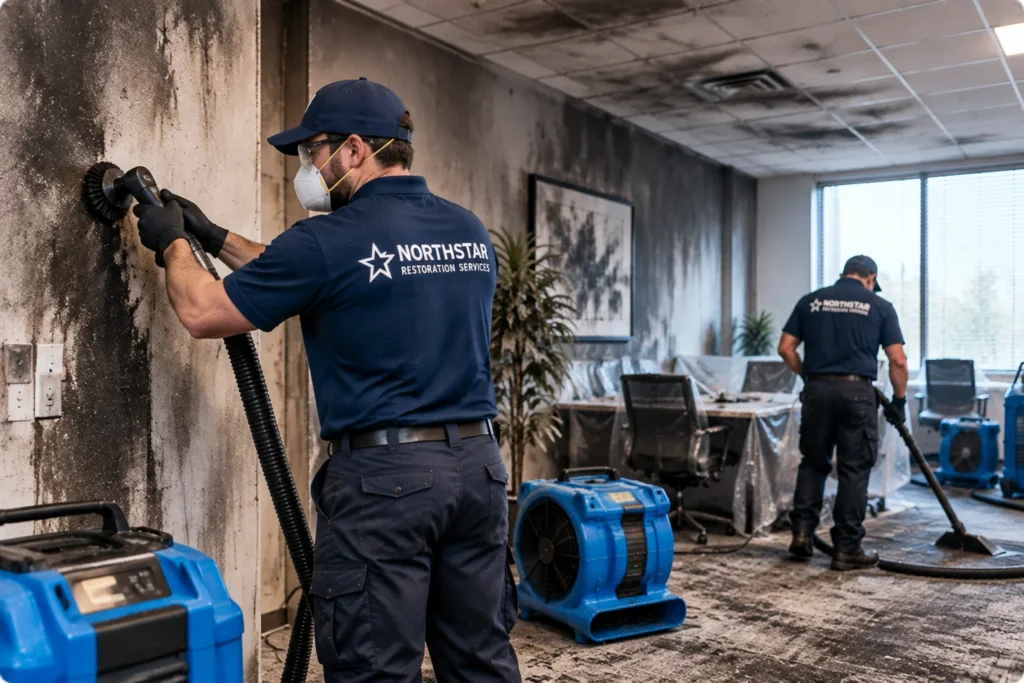
Work methods should limit unnecessary movement of loose residue into unaffected areas. Depending on the project, technicians may use barriers, controlled work zones, localized collection, or HEPA air scrubbing where appropriate to the actual scope. The work plan should also consider employee routes, customer areas, occupied sections, elevators, loading zones, and other pathways that could move debris or interfere with operations.
4. Remove Loose Residue Before Wet Cleaning
Loose particulate material should generally be collected before aggressive wiping or washing.
Appropriate vacuuming, dry-cleaning tools, or other methods can reduce the chance of smearing residues across sensitive finishes.
Professional soot removal services should be based on the residue and substrate. Painted walls, glass, metal, masonry, flooring, finished wood, electronics, and textiles can respond differently to the same technique.
5. Match Cleaning Methods to the Surface
Professional restoration should use surface-specific cleaning instead of one universal chemical or process. The technician should consider:
- Material type
- Surface finish
- Heat exposure
- Residue characteristics
- Existing coatings
- Accessibility
- Restoration goal
IICRC S700 covers practical restoration-cleaning methods, tools, equipment, and materials for buildings and contents, reinforcing the need for a documented work plan rather than a one-product-fits-all approach. For absorbent materials, porous material restoration requires a separate decision about whether the material can be effectively cleaned, deodorized, and retained or whether removal is more appropriate.
6. Evaluate and Protect Contents
Commercial smoke losses can affect furniture, stock, documents, equipment, textiles, tools, electronics, displays, and tenant or customer property. A commercial contents cleaning plan should document:
- Which items remain on site
- Which items need specialized handling
- Which items are moved off site
- Which items may not be restorable
- Who authorizes disposal
ATI’s current San Francisco fire-and-smoke page prominently includes contents cleaning and restoration, salvageable-item recovery, soot and odor removal, and commercial-scale service. That is a useful competitor benchmark for the level of scope clarity NorthStar should match with its own first-party process.
7. Evaluate HVAC and Building Systems
Smoke can move through air pathways, but the correct response is assessment-driven rather than automatically cleaning every duct after every incident. An HVAC smoke assessment should determine whether fire residues or odors affected accessible components and what specific parts of the system belong in the restoration work plan.
IICRC S700 explicitly includes HVAC and other building systems within the assessment scope. NorthStar’s current page states that its process includes HVAC shutdown and protection of supply and return openings. The updated page should distinguish system assessment from automatic whole-system treatment.
8. Address Odor After Source Cleaning
Persistent odor is best treated as a source-control problem first. Smoke odor source removal means identifying and cleaning or removing odor-holding residue and materials before relying on secondary treatment. A professional odor removal plan may involve source cleaning, removal of non-restorable materials, ventilation, filtration, and another project-specific process.
If NorthStar uses thermal fogging treatment, hydroxyl odor treatment, or ozone odor treatment, explain:
- Why that method was selected
- What conditions justify it
- Which materials or areas are involved
- Whether occupancy restrictions apply
- What preparation is required
- How the result will be evaluated
Do not present these technologies as automatic steps for every smoke loss.
IICRC S700 specifically addresses fire odor management as part of professional restoration cleaning.
9. Document Completion and the Next Phase
The emergency cleaning phase should end with a documented understanding of:
- What was cleaned
- What was removed
- Which contents remain in processing
- What remains unresolved
- Whether repair work is required
- Which areas are ready for the next phase
If the loss also requires structural repairs or commercial reconstruction support, transition the customer to the broader fire-damage scope rather than duplicating rebuilding content throughout this smoke-focused page. ATI similarly separates cleaning and decontamination from structural repairs and wider disaster-recovery capabilities.
Smoke Damage Without Major Structural Fire Damage
Not every commercial smoke loss involves extensive burned building materials. A small electrical event, cooking fire, equipment malfunction, neighboring fire, or contained incident can produce widespread residue and odor even where structural damage is limited.
That is where dedicated smoke remediation services have a distinct search intent. The page should answer questions about:
- Residue migration
- Soot
- Odor
- Contents
- HVAC evaluation
- Cleaning methods
- Return-to-use decisions
without becoming a duplicate of the commercial fire page. This distinction is especially important because NorthStar already maintains separate commercial fire and smoke URLs. The smoke page should be the deeper resource for residue and odor decisions, while the fire page should own structural damage, suppression-water impact, stabilization, and rebuilding.
Protect Business Operations During Restoration
A commercial project is not only a cleaning problem. It is also an operations problem. Effective business interruption planning should identify:
- Which spaces are critical
- Which areas can remain closed
- Whether work can be phased
- Which customer routes must remain available
- Which employee areas are essential
- What equipment or inventory has priority
- What conditions must be met before reopening
NorthStar’s PREP Planning program is directly relevant for businesses that want documented infrastructure, communication protocols, predetermined expectations, and priority response before a future loss occurs. NorthStar describes PREP as a collaboration with commercial and large-loss clients designed to support faster and more efficient recovery.
Insurance and Project Documentation
A smoke-loss file may include:
- Initial photographs
- Affected-area notes
- Residue observations
- Contents inventories
- Cleaning decisions
- Equipment records
- Disposal authorizations
- Estimates
- Invoices
- Repair recommendations
Good insurance claim documentation makes the project easier for owners, property managers, adjusters, and carriers to understand. However, the restoration contractor should not promise coverage.
Coverage depends on the policy, cause of loss, endorsements, exclusions, limits, and insurer determination. The current NorthStar page says the company works with insurance carriers and documents losses, which is useful, but its wording about typical coverage should remain conditional.
What Affects Pricing?
Commercial smoke cleanup cost depends on the scope of the actual loss rather than one generic square-foot figure. Important variables can include:
- Size of the affected area
- Intensity of residue
- Number of rooms or floors
- Materials involved
- Contents volume
- HVAC impact
- Cleaning methods
- Access restrictions
- After-hours scheduling
- Odor-management requirements
- Repair requirements
A useful estimate should separate major phases so the customer understands exactly what is included.
For example:
Assessment and documentation → residue cleaning → contents work → system-related work where justified → odor management → separate repair scope.
NorthStar should avoid publishing generic example dollar amounts unless those figures come from a current, operationally supportable pricing model.
Why Choose NorthStar in Wausau?
NorthStar states that it is based in Wausau and has more than 100 years of combined restoration experience. Its About page also describes PREP planning for commercial and large-loss clients.
The current smoke page also surfaces 24-hour availability and hundreds of Google reviews, but the stronger E-E-A-T opportunity is to add smoke-specific first-party proof directly to this page. NorthStar should show:
- A named project manager
- Verified fire/smoke credentials
- Original Wausau-area project photographs
- Actual residue conditions
- Actual cleaning equipment and products
- A real contents decision
- A documented HVAC decision
- Before-and-after evidence
- A customer review tied to an actual smoke-loss project
Users can review NorthStar’s About Us page and recent projects and reviews before choosing a provider. For additional educational context, NorthStar’s article on why smoke odor can return after cleaning is a relevant internal resource, but its stronger health and “permanent removal” claims should be reviewed before the article is used as a major authority-supporting link.
Schedule Commercial Smoke Damage Cleanup in Wausau
If soot, smoke residue, or persistent odor is affecting your business after a fire or smoke event, contact NorthStar once the property is available for appropriate restoration access. When you call, provide:
- Property address
- Facility type
- Areas affected
- Date of the incident
- Whether the HVAC system was operating
- Whether contents or inventory are involved
- Whether suppression water affected the property
- Name of the person authorized to approve work
For broader fire-related structural damage, use NorthStar’s commercial fire damage cleanup service. For proactive commercial planning, review Commercial Benefits & Services and PREP Planning.
Need 24/7 Help?
Contact NorthStar with the basic loss details above so the team can establish the first inspection and recovery priorities. The first conversation should answer:
- Where did the smoke travel?
- Which materials and contents are affected?
- Did the HVAC system become involved?
- What needs immediate cleaning or protection?
- Which areas are most important to business operations?
- What documentation is required?
Frequently Asked Questions
Begin the professional assessment as soon as the site can be accessed appropriately and the relevant authorities or property representatives permit restoration work.
The exact sequence depends on the fire event, safety conditions, residue distribution, water impact, and business priorities.
Yes.
Smoke-focused work centers on residue, soot, odors, contents, and building-system impact.
Fire-damage restoration may additionally involve burned materials, structural repairs, suppression water, stabilization, and rebuilding.
No.
The system should be evaluated when the event and observed conditions indicate that residues or odors may have affected HVAC components.
IICRC S700 includes HVAC within the assessment scope, but that does not make full-system cleaning automatic in every case.
No.
Restorability depends on the material, residue, heat exposure, physical condition, finish, accessibility, odor retention, and the practical value of cleaning compared with replacement.
Odor treatment should not substitute for source cleaning.
The work plan should address residue and odor-holding materials first, then use additional odor-management methods where justified by the remaining conditions.
IICRC S700 treats fire odor management as part of the overall restoration process.
Coverage depends on the policy and loss.
NorthStar can document conditions, work, contents, and estimates, but the insurer and policy determine coverage.
Sometimes.
That decision depends on affected zones, access restrictions, work methods, building systems, business type, and whether unaffected areas can be kept adequately separate from restoration activity.
Ask who will manage the project, what credentials are relevant, how residue boundaries will be established, which areas and contents are included, how HVAC decisions are made, what odor methods may be used, how the completed work will be documented, and what is excluded from the estimate.
Proudly Serving Central Wisconsin
Looking for something else?
Water Damage Cleanup
Residential Water Damage Restoration
Flooding & Water Damage Repair
Your Business Deserves Smoke Damage Restoration You Can Trust
A fire in your commercial property leaves behind more than just burned materials. It leaves smoke residues that threaten your building’s structure, odors that drive away customers, and the overwhelming feeling that you’ll never get your business back to normal. But here’s what I want you to remember as you stand in the aftermath: this moment doesn’t define your business. How you respond to it does. And you don’t have to respond alone.
When you search for fire damage restoration companies, you’re looking for more than someone with cleaning products and a truck. You’re looking for a partner who understands the stress you’re under, who has the expertise to handle the complexity of smoke damage, and who will guide you through the process with clarity and compassion.
At NorthStar Restoration Services, we combine 24/7 emergency response with certified expertise in smoke damage restoration. Our technicians hold triple-master certifications across water, fire, smoke, and textile restoration disciplines. We’ve helped hundreds of businesses across Central Wisconsin recover from fires, and we’re ready to help yours. Don’t let smoke damage threaten everything you’ve built. Call the professionals who understand the urgency and have the experience to handle it right. Call us today at (866) 439-9318. We’re standing by 24/7 to respond to your fire and smoke emergency.