
NorthStar Restoration Services
Commercial Water Removal Service in Wausau, WI
Commercial Water Removal Service helps businesses respond quickly when standing water affects offices, retail stores, healthcare facilities, apartment buildings, restaurants, warehouses, schools, and industrial properties. The first priority is to control the water source when it is safe to do so and remove bulk water before it spreads farther into the building.
NorthStar Restoration Services provides Commercial Water Removal Service for businesses in Wausau and Central Wisconsin with 24-hour emergency availability. NorthStar’s current site lists 24-hour emergency response and identifies Wausau as its home base.
A Commercial Water Removal Service is the emergency phase of a water-loss response that focuses on assessing the affected area, removing standing or pooled water, identifying where moisture has migrated, and setting up the next drying steps. It is not the same as a complete restoration project.
The ANSI/IICRC S500 standard covers procedures and precautions for professional water-damage restoration in residential, commercial, and institutional buildings, making a documented assessment and technically appropriate response more credible than a generic “pump out the water” approach.
For property managers searching for commercial water removal near me, the most useful provider is one that can clearly explain what water is being removed, what equipment is being used, how hidden moisture is checked, which areas can remain operational, and what happens after bulk extraction is complete.
When Professional Extraction Is Needed
Commercial water extraction may be necessary after burst plumbing, sprinkler discharge, roof intrusion, appliance failure, stormwater entry, sump or drainage problems, or another event that leaves significant water inside a building.
The response should be based on the actual source and conditions. Water from a clean plumbing line is handled differently from a loss involving sewage or another significant contamination source. If sewage is involved, use NorthStar’s commercial sewage cleanup service rather than treating the project as a routine extraction job. NorthStar already maintains a dedicated commercial sewage page for that separate loss type.
Common conditions that justify an urgent assessment include:
- Visible standing water
- Water spreading under walls or flooring
- Saturated carpet or pad
- Wet ceiling or wall materials
- Water around inventory or equipment
- A leak that continued while the building was unoccupied
- Moisture appearing in adjacent rooms
- A commercial space that cannot safely return to normal use
Our Commercial Water Removal Service Process
A strong Commercial Water Removal Service should move from immediate safety and source control to extraction, measurement, drying setup, and documentation without blurring the line between emergency removal and full reconstruction.
1. Emergency Contact and Site Assessment
The first call should establish:
- What happened
- Whether water is still entering the property
- Which areas are affected
- Whether electrical or other utilities may be involved
- Who has authority to approve emergency work
- Which areas are critical to business operations
NorthStar should identify customer-facing areas, server rooms, inventory, healthcare spaces, tenant areas, manufacturing zones, or other sections where downtime creates greater operational impact.
SERVPRO’s competitor page puts lost productivity and revenue directly into its commercial water-loss positioning and then moves quickly into extraction, mitigation, repair, and restoration.
2. Stop or Isolate the Source When Safe
Extraction will not solve the problem if water is still entering the building.
The source may need to be shut off, isolated, repaired, or referred to the appropriate plumber, roofer, utility provider, fire-protection contractor, or other specialist.
The restoration scope should remain clear about which repair work NorthStar performs directly and which work requires another trade.
3. Begin Bulk Extraction
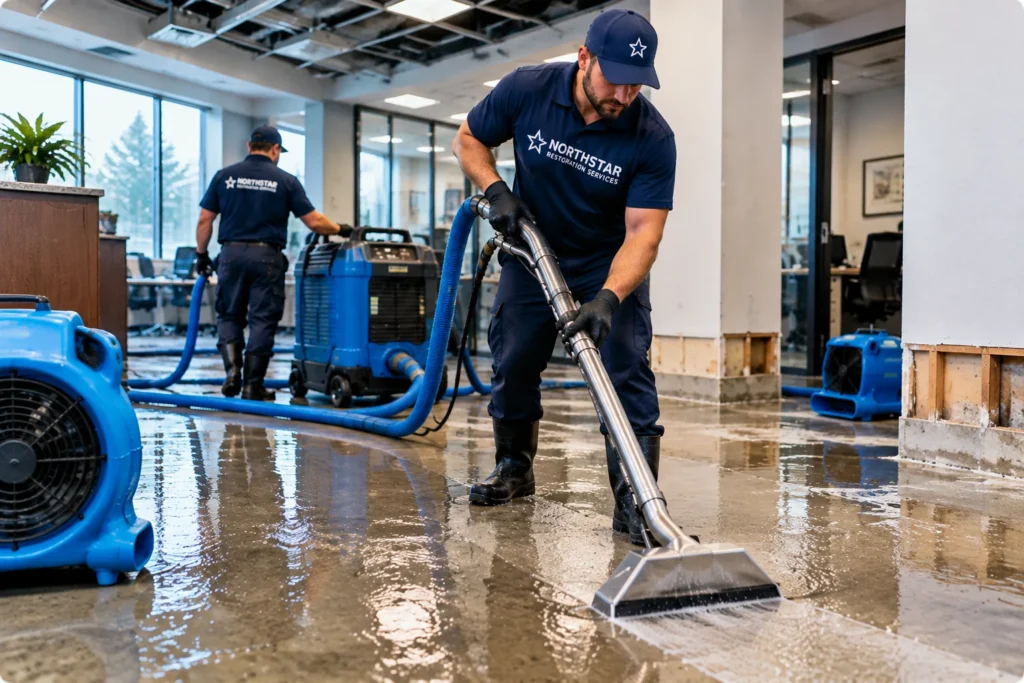
Emergency water extraction focuses on removing bulk water from accessible surfaces and materials as quickly and safely as site conditions allow.
Depending on the property, the project may require pumps, truck-mounted extraction units, portable extractors, hoses, or other water extraction equipment.
NorthStar’s existing live page currently describes truck-mounted units, submersible pumps, portable extractors, air movers, dehumidifiers, thermal-imaging cameras, and moisture meters as part of its commercial response equipment.
4. Remove Standing Water Systematically
Standing water removal should be organized around:
- Building layout
- Water depth
- Access
- Affected materials
- Adjacent rooms
- Equipment and inventory
- Floor levels
- Safety conditions
Large open areas may require a different approach from offices, stairwells, basements, mechanical rooms, or rooms filled with shelving and equipment. The objective is to reduce bulk water efficiently without unnecessarily disturbing areas that remain unaffected.
5. Check How Far Moisture Has Traveled
Water often migrates beyond the area that visibly looks wet.
Moisture mapping can help document affected materials and guide the transition from extraction to drying. NorthStar’s current page already states that it uses thermal imaging and moisture meters to identify hidden moisture and guide the drying strategy.
Thermal imaging can help identify temperature patterns that may warrant further investigation, while moisture meters provide readings in specific materials.
These tools should support professional judgment rather than be marketed as stand-alone proof that every concealed space is dry.
ATI makes this measurement step especially clear in its competitor content by describing moisture mapping, leak detection, estimates based on loss size, removal, drying, and ongoing moisture monitoring.
6. Transition From Extraction to Drying
After bulk water is removed, moisture may remain in carpet, pad, drywall, wood, insulation, flooring assemblies, and other porous materials.
At that point, water mitigation decisions may include:
- Air movement
- Humidity control
- Selective material removal
- Additional inspection
- Isolation of affected areas
Structural drying belongs to the next phase and should be monitored according to actual material conditions and documented drying goals rather than one arbitrary number of days. Where indoor humidity must be reduced, commercial dehumidification can be incorporated according to the affected area, environmental conditions, and material load. IICRC’s S500 provides a recognized framework for professional water-loss procedures and precautions rather than treating drying as simply “putting fans in a room.”
7. Document the Emergency Phase
A useful commercial-loss file can include:
- Initial photographs
- Source information
- Affected-area notes
- Moisture readings
- Equipment placement
- Extraction activity
- Monitoring records
- Materials removed
- Customer approvals
- Conditions requiring another specialist
Good insurance claim documentation can make the scope easier for owners, managers, adjusters, and carriers to understand. However, a restoration contractor should not promise that a specific insurance claim is covered. Coverage depends on the policy, cause of loss, exclusions, limits, endorsements, and insurer determination.
What Happens After the Water Is Removed?
Bulk extraction is only one stage of recovery. Once immediate removal is complete, the project may move into:
- Continued drying
- Cleaning
- Contents handling
- Controlled demolition
- Material replacement
- Repair
- Reconstruction
Those broader recovery topics should primarily live on NorthStar’s commercial water damage restoration page rather than being duplicated extensively here. NorthStar’s current restoration page already covers end-to-end recovery and reconstruction.
If microbial growth becomes a separate concern after a moisture problem, use NorthStar’s mold damage restoration service for that specific search intent.
How Fast Should Wet Materials Be Addressed?
Water-damaged materials should be addressed promptly. EPA guidance for water-damaged buildings includes strategies for drying many wet materials within 24–48 hours when possible to reduce the likelihood of mold growth.
That guidance should not become an absolute claim that every building will be dry within 24–48 hours or that mold automatically begins at an exact hour. Drying depends on:
- Material type
- Water volume
- Temperature
- Humidity
- Construction
- Accessibility
- Air movement
- Dehumidification
- Source conditions
The stronger message is: Remove bulk water promptly, begin appropriate drying, monitor the materials, and correct the source.
Flood and Storm-Related Water
Flood water removal can involve water entering from severe weather, drainage failure, snowmelt, roof damage, groundwater, or another exterior source.
The source and contamination conditions matter. Water that has contacted soil, sewage, chemicals, or other contaminants may require additional controls.
For larger weather-related losses, commercial flood cleanup can be coordinated with NorthStar’s storm damage cleanup service.
Burst Pipes and Plumbing Failures
Burst pipe cleanup usually starts with safely isolating the water source and then extracting water from the affected areas. Commercial losses can become complex because water may move through:
- Multiple rooms
- Several floors
- Wall assemblies
- Tenant spaces
- Storage areas
- Mechanical areas
- Equipment rooms
Leaks that occur overnight or over a weekend can spread before staff discover them. The response should combine source control, extraction, documentation, moisture assessment, and a clear handoff into drying.
Reducing Operational Disruption
A water emergency can affect much more than building materials. It can interrupt:
- Customers
- Employees
- Tenants
- Production
- Records
- Inventory
- Deliveries
- Critical equipment
The project manager should discuss business interruption early and identify which areas are essential to continued operations. Where site conditions permit, work may be phased or isolated so unaffected sections can remain usable. No restoration provider should promise zero downtime. A more credible commitment is to communicate clearly, prioritize critical areas, and sequence work to reduce avoidable disruption.
NorthStar’s PREP Planning program is a useful internal resource for commercial clients who want to document infrastructure, priorities, emergency contacts, and response expectations before a disaster occurs. NorthStar describes PREP as a collaboration with commercial or large-loss clients designed to prepare the property and support a faster recovery.
What Does Commercial Water Removal Cost?
The cost of a Commercial Water Removal Service depends on the actual emergency scope. Common cost factors include:
- Volume and depth of water
- Size of affected area
- Water source
- Contamination concerns
- Number of rooms or floors
- Accessibility
- Equipment requirements
- After-hours response
- Materials affected
- Length of extraction work
- Monitoring needs
- Specialty access or safety requirements
NorthStar’s current page already uses volume, water category, accessibility, time since intrusion, materials, and equipment needs as pricing factors. A better commercial estimate separates:
Phase 1 — Immediate removal and stabilization
Phase 2 — Drying, restoration, repair, and reconstruction
That makes the scope easier to compare and reduces confusion between this page and the broader restoration service.
Why Choose Us?
Choosing NorthStar means choosing trust. We’re known for:

24/7 emergency response
Expert, certified technicians
Complete cleanup, repair, and rebuild under one roof
Transparent communication and honest pricing
Community-driven service
BBB A+ accredited and locally trusted
We’re proud to be BBB A+ accredited and locally trusted for fast, effective, and compassionate restoration.
When disaster hits, we’re here — Restoring your peace of mind with over 100 years of combined experience. Fast, reliable, and local to Wausau when every second counts.
What Should You Do Before the Crew Arrives?
If it is safe to do so:
- Stop or isolate the water source.
- Keep employees and customers away from hazardous areas.
- Avoid areas where water may contact electrical systems.
- Identify the person authorized to approve emergency work.
- Gather building-access information.
- Protect critical records or equipment only when it can be done safely.
- Photograph visible conditions without delaying emergency response.
- Tell the response team about sewage, chemicals, medical waste, or other site hazards.
Do not enter an unsafe area simply to save property.
Schedule Commercial Water Removal Service
If standing water is affecting your Wausau-area business, contact NorthStar for a rapid assessment and extraction plan.
For 24/7 water removal, provide:
- Property address
- Facility type
- Source of water, if known
- Whether the source is controlled
- Approximate affected area
- Water depth, if known
- Critical business areas
- Access instructions
- On-site decision-maker information
- Known sewage, chemical, electrical, or structural hazards
NorthStar’s site currently displays (715) 302-0529 in its 24-hour header, while the Contact page identifies (866) 439-9318 as its emergency-service number; that inconsistency should be resolved before publishing the final CTA.
For broader reconstruction and complete property recovery after extraction, continue to NorthStar’s commercial water damage restoration service.
Frequently Asked Questions About Commercial Water Removal Services
Water removal focuses on extracting bulk or standing water and stabilizing the immediate loss.
Restoration is broader and may include continued drying, cleaning, demolition, contents work, repair, and reconstruction. NorthStar currently has separate URLs for both services, so this distinction should remain explicit.
As soon as the site can be addressed safely and the source and major hazards are controlled.
Prompt action reduces the amount of time water has to migrate farther into materials and adjacent areas.
Professional assessment can combine visual inspection, moisture meters, thermal imaging, building-material knowledge, and additional investigation where justified.
NorthStar’s current page explicitly identifies thermal imaging and moisture meters as part of its process.
No.
Bulk extraction removes liquid water, but moisture may remain inside porous materials and concealed assemblies. Drying and verification are separate steps.
Sometimes.
The answer depends on the affected areas, source, electrical or structural conditions, contamination, equipment placement, noise, and whether the work area can be separated safely from normal operations.
Coverage depends on the specific policy and loss.
NorthStar can document conditions and work performed, but the content should avoid the current site’s broad statement that most commercial policies cover the service as though coverage were automatic. The live page presently uses that wording.
Depending on conditions, professional responders may use pumps, truck-mounted extractors, portable extractors, hoses, moisture meters, thermal-imaging equipment, air movers, and dehumidifiers.
NorthStar currently lists these types of tools on its live commercial water page.
Treat the loss as a separate contamination scenario rather than routine extraction.
NorthStar maintains a dedicated commercial sewage cleanup page for that service.
Proudly Serving Central Wisconsin
Looking for something else?
Water Damage Cleanup
Residential Water Damage Restoration
Flooding & Water Damage Repair
Your Business Deserves Professional Water Removal You Can Trust
Water emergencies don’t schedule themselves around your business hours. They arrive without warning, often at the worst possible moment, threatening everything you’ve built. When water invades your commercial property, you need a restoration partner who responds immediately, works efficiently, and understands the urgency of protecting your business assets. You don’t have to search for water removal services near me and hope you find someone reliable. You already know who the trusted experts are in Central Wisconsin.
At NorthStar Restoration Services, we combine 24/7 emergency response with certified expertise in commercial water removal. Our technicians hold advanced certifications in water damage restoration and follow strict protocols designed to extract water quickly and dry your property thoroughly. We work with your insurance carrier, handle the entire restoration process, and communicate clearly every step of the way.
Don’t let standing water threaten your business operations, your inventory, or your peace of mind. Call the professionals who understand the urgency and have the experience to handle it right.
Call us today at (866) 439-9318. We’re standing by 24/7 to respond to your water emergency.