
NorthStar Restoration Services
Commercial Carpet Cleaning for Wausau Businesses
A clean business environment starts from the floor up. NorthStar Restoration Services provides Commercial Carpet Cleaning for offices, retail spaces, schools, healthcare settings, hospitality properties, multi-family buildings, and other workplaces across Wausau and Central Wisconsin.
The service should be designed around the condition of the carpet, traffic level, type of soil, operating schedule, and the amount of downtime your facility can reasonably allow.
For property managers and business owners comparing commercial carpet cleaning in Wausau, WI, the most useful question is not simply, “How often should the carpet be cleaned?” It is: What maintenance plan fits this facility, this traffic pattern, and this carpet system?
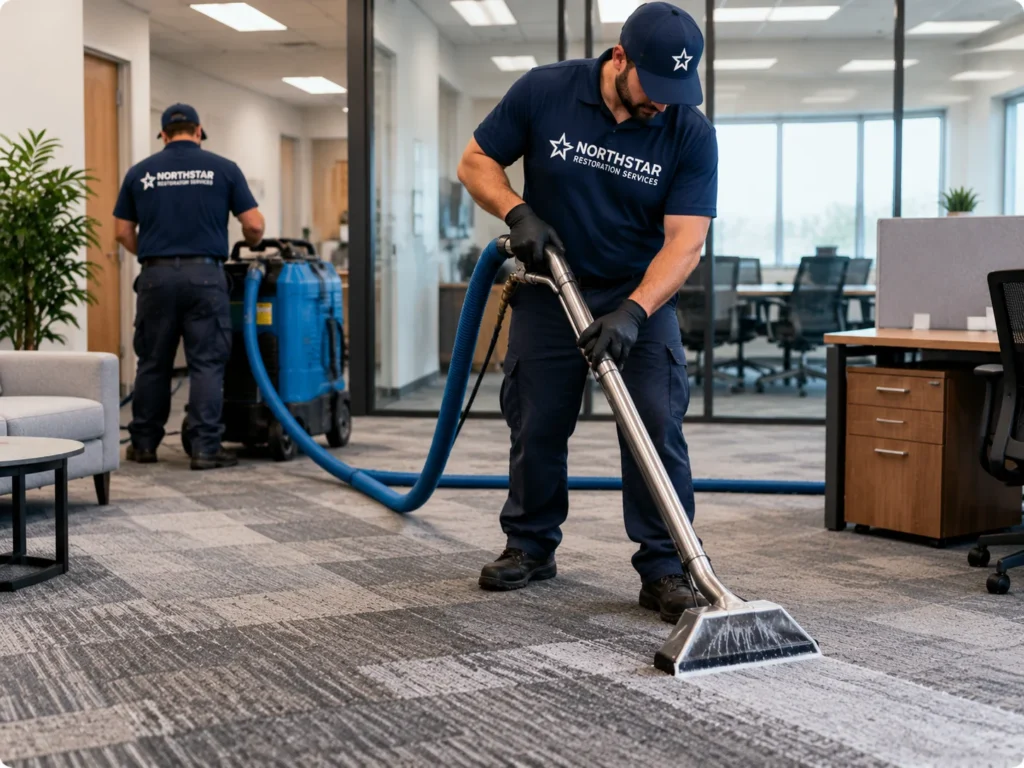
Carpet Cleanliness Matters
Professional service should begin with an inspection rather than a one-size-fits-all cleaning method.
A technician should evaluate:
- Carpet fiber and construction
- Traffic patterns
- Entry areas
- Oily or embedded soil
- Spots and spills
- Previous treatments
- Moisture conditions
- Furniture and access
- Operating-hour limitations
- Areas requiring special attention
Businesses searching for commercial carpet cleaning near me should expect a defined scope explaining what will be cleaned, which process is recommended, how problem areas will be treated, what drying conditions to expect, and how work can be scheduled around customers, employees, tenants, or patients.
A complete plan may combine preventive care, interim cleaning, periodic restorative work, localized spot treatment, and appearance-management procedures.
The ANSI/IICRC S100 standard covers professional maintenance and cleaning of textile floor coverings and addresses evaluation of carpet types, conditions, soil removal, cleaning procedures, and appearance retention.
Facilities We Can Help Maintain
Different commercial properties create different flooring challenges. Cleaning should reflect how each building is actually used.
Offices and Corporate Spaces:
Office carpet cleaning commonly focuses on entrances, hallways, reception areas, conference rooms, break spaces, workstations, and other locations where foot traffic and beverage spills accumulate. A professional plan can prioritize visible customer-facing areas without treating every room as if it receives identical use.
Healthcare and Senior Living Properties:
Facility carpet cleaning may require additional coordination around occupied areas, access restrictions, internal policies, traffic flow, patient or resident schedules, and rooms that cannot all be taken out of service simultaneously.
Retail Stores and Customer-Facing Businesses:
Retail environments often experience concentrated traffic around:
- Main entrances
- Registers
- Customer-service areas
- Fitting rooms
- Waiting spaces
- Product displays
Cleaning can be staged to keep the most important business areas available.
Schools, Daycares and Community Facilities:
These properties may face concentrated traffic, food spills, tracked seasonal debris, and narrow scheduling windows. Service can be planned during evenings, weekends, breaks, or in sections where operational requirements permit.
Hotels, Restaurants and Hospitality Properties:
Lobbies, corridors, conference areas, waiting spaces, dining areas, and other guest-facing zones may require more frequent appearance care than administrative or restricted areas.
Multi-Family and Property-Managed Buildings:
Common corridors, entryways, leasing offices, stairs, amenity areas, and turnover units can be incorporated into a maintenance plan according to actual occupancy and traffic.
Our Commercial Carpet Cleaning Process
A consistent process makes the scope easier for a property manager to understand, approve, and monitor.
1. Facility Walkthrough and Condition Assessment
We begin by reviewing:
- Carpeted areas
- Traffic patterns
- Visible spotting
- Entry zones
- Recurring problem areas
- Furniture constraints
- Security requirements
- Access windows
- Business-hour restrictions
This inspection helps distinguish routine appearance problems from conditions requiring deeper corrective work.
2. Select the Appropriate Method
Different carpets and soil conditions can require different approaches. Hot water extraction may be appropriate when deeper restorative soil removal is necessary. Low-moisture carpet cleaning may be useful in selected applications where reduced moisture or shorter operational disruption is an important consideration. The carpet construction, soil condition, manufacturer guidance, and facility requirements should drive the choice.
3. Remove Dry Soil
Dry particulate material should be addressed before wet treatment where appropriate. Commercial entryways can accumulate:
- Sand
- Grit
- Dust
- Mud
- Salt
- Outdoor debris
Removing dry soil before deeper treatment helps the remaining cleaning process focus on more difficult contamination.
4. Precondition and Treat Problem Areas
Targeted chemistry can help loosen oily traffic soil and prepare difficult areas for extraction or agitation. Separate stain and odor treatment may be appropriate for coffee, beverages, food, tracked oils, organic material, or other localized contamination. The correct treatment depends on what caused the spot and how deeply it has penetrated.
5. Perform Interim Cleaning Where Appropriate
Some maintenance programs may incorporate bonnet cleaning when surface-level appearance work is suitable. Other applications may use carpet shampooing where agitation and the carpet system support that approach. These methods should be selected based on the actual flooring rather than because one technique is marketed as universally superior.
6. Deep Extraction and Soil Recovery
When more restorative cleaning is needed, carpet extraction services use appropriate solution, agitation when required, and recovery equipment to remove suspended soil and moisture. Professional standards emphasize evaluating the carpet’s construction, condition, soil level, and appropriate methodology rather than prescribing one cleaning system for every project.
7. Final Inspection and Drying Guidance
After cleaning, the technician should review:
- Remaining spots
- Traffic restrictions
- Furniture placement
- Ventilation
- Drying expectations
- Areas requiring additional attention
Drying varies according to humidity, airflow, carpet density, temperature, cleaning method, amount of moisture introduced, and recovery efficiency. A project-specific expectation is more credible than a universal one-hour or same-day promise.
Interim Cleaning vs. Restorative Cleaning
A strong commercial carpet maintenance program separates routine appearance care from deeper restorative cleaning.
Interim service focuses on maintaining appearance between deeper visits. It may concentrate on entrances, hallways, reception zones, and visible traffic lanes before the entire facility requires intensive treatment.
Restorative cleaning is more aggressive and may be appropriate after soil has accumulated beyond what routine maintenance can effectively manage.
This becomes particularly important with high-traffic carpet cleaning in:
- Main lobbies
- Public corridors
- Reception spaces
- Elevator areas
- Frequently occupied meeting rooms
- Customer-service zones
Separating these objectives can help avoid waiting until an entire floor looks neglected before corrective work begins.
How Often Should Business Carpets Be Professionally Cleaned?
There is no single professional-cleaning calendar appropriate for every building. Frequency should be determined by:
- Foot traffic
- Soil load
- Type of facility
- Carpet construction
- Manufacturer requirements
- Seasonal weather
- Entryway controls
- Appearance expectations
- Operating conditions
The Carpet and Rug Institute recommends increasing vacuuming frequency with traffic. Its business guidance calls for daily vacuuming in high-traffic areas, twice weekly in medium-traffic locations, and weekly in lighter-use areas. For many properties, scheduled carpet cleaning works better when the facility is separated into maintenance zones.
High-Use Zones
Examples include:
- Main entrances
- Reception areas
- Elevators
- Main corridors
- Break rooms
These zones should be inspected more often and maintained according to visible soil and actual use.
Moderate-Use Zones
Examples may include:
- Conference rooms
- General office areas
- Secondary hallways
- Shared staff spaces
Lower-Use Zones
These may include:
- Limited-access rooms
- Low-use offices
- Storage-adjacent areas
- Restricted administrative spacesInstead of treating every square foot on the same schedule, the service provider can develop interim and restorative cycles according to actual conditions.
Reduce Disruption to Your Business
Professional cleaning should support operations rather than create avoidable downtime.
NorthStar can plan business carpet cleaning around access, occupancy, furniture, security requirements, and the hours when each area is available.
Where the project and facility permit, after-hours carpet cleaning can help keep customer-facing or employee areas available during normal business hours.
Before work begins, identify:
- Areas that must remain operational
- Rooms that can be temporarily closed
- Security requirements
- Keys or access credentials
- Sensitive equipment
- Furniture restrictions
- Noise limitations
- Drying-time constraints
- Loading or parking access
For businesses that want broader continuity planning, NorthStar’s PREP Planning program is designed around proactive preparation for commercial properties. NorthStar states that PREP clients work with its team to document property information and prepare response plans before an emergency occurs.
Which Cleaning Method Is Best for a Commercial Facility?
A commercial carpet cleaner should be able to explain why a particular method fits your flooring instead of automatically prescribing the same system throughout the building.
Deep Restorative Extraction
Water-based restorative cleaning can be appropriate where embedded soil or residues require deeper removal. The recommendation should account for:
- Fiber type
- Construction
- Carpet condition
- Soil level
- Manufacturer instructions
- Facility requirements
Lower-Moisture Approaches
Methods using less moisture can support appearance management where faster return-to-use is an important operational concern. However, reduced moisture does not automatically make a process superior for heavy or deeply embedded soil.
Interim Appearance Methods
Surface-oriented cleaning can be used between deeper restorative visits where specific traffic areas require improvement. The objective is not to select whichever method has the strongest marketing slogan. The objective is to match the system to the flooring, soil condition, operating environment, and expected result.
Stains, Odors and Commercial Problem Areas
Commercial flooring can be affected by:
- Coffee
- Soft drinks
- Food
- Tracked oils
- Winter grime
- Ink
- Gum
- Organic material
- Heavy traffic
- Previous cleaning residues
Some spots can respond very well to professional treatment.
Others may involve:
- Permanent discoloration
- Dye loss
- Fiber damage
- Wear
- Contamination below the visible surface
A responsible technician should distinguish between removable soil and permanent damage before promising an outcome. Where compatible with the flooring, a carpet protector may also be considered after cleaning to support future maintenance in traffic-prone areas. For properties with multiple flooring surfaces, a broader commercial floor care strategy can include NorthStar’s tile and grout cleaning service so carpeted and hard-surface areas are not managed as unrelated projects. NorthStar offers carpet, upholstery, tile, and grout cleaning among its cleaning capabilities.
Central Wisconsin Weather and Entryway Soil
Wisconsin businesses experience seasonal conditions that can significantly change what enters a building.
Winter
Entry zones may experience:
- Road salt
- Sand
- Snow
- Slush
- Moisture
- Grit
Spring
Mud and tracked moisture can increase.
Summer
Dust and outdoor debris may become more noticeable.
Fall
Leaves, soil, and moisture can concentrate around entrances.
Walk-off mats, regular vacuuming, rapid spot response, and targeted entry-zone care can reduce how far abrasive material travels into a facility. CRI likewise emphasizes more frequent vacuuming in areas receiving heavier traffic.
Make Eco-Conscious Decisions Based on Evidence
Eco-friendly commercial cleaning should mean identifiable product and process choices rather than an unsupported “green” marketing statement.
Facility managers can ask:
- Which products will be used?
- Are safety data sheets available?
- Is the chemistry compatible with the flooring?
- Is fragrance optional?
- How much moisture will be introduced?
- How is wastewater managed?
- What ventilation is recommended?
- Are manufacturer-specific instructions being followed?
These questions are particularly useful when environmental policies, employee sensitivities, building requirements, or sustainability goals affect purchasing decisions.
What Does Professional Commercial Service Cost?
A commercial project should normally be priced according to its actual scope rather than a residential-style “per room” figure. Common cost variables include:
- Total cleanable square footage
- Number of areas
- Carpet construction
- Soil level
- Spot-treatment requirements
- Odor concerns
- Furniture movement
- Stairs
- Access restrictions
- Off-hours requirements
- Frequency of recurring visits
- Drying and occupancy limitations
A useful commercial cleaning quote should define:
- The areas included
- The cleaning method
- Specialty treatment
- Scheduling conditions
- Major exclusions
- Any recommended recurring program
That makes the estimate easier for an owner, facility manager, or procurement team to compare accurately.
Why Choose NorthStar for a Wausau Business?
NorthStar Restoration Services is based in Wausau and states that its team has more than 100 years of combined experience. Its About page also displays IICRC certification among the company’s credentials and identifies carpet, tile, and upholstery cleaning among the work its trained team performs.
That broader restoration background can become useful when a flooring concern is connected to:
- Water intrusion
- Persistent moisture
- Odor
- Material damage
- A larger property-loss event
NorthStar also provides broader commercial benefits and services and commercial restoration support when a facility problem extends beyond routine floor cleaning.
Before scheduling, property managers can review NorthStar’s company background and credentials and recent projects and reviews.
Eco-friendly cleaning
If carpeted areas are showing traffic lanes, stains, odors, seasonal soil, or an overall worn appearance, NorthStar can assess the facility and recommend an appropriate scope. Use the Request an Estimate page and provide:
- Type of facility
- Approximate carpeted square footage
- Priority areas
- Primary problems
- Preferred scheduling window
- Access limitations
- Stain or odor concerns
A productive first conversation should answer five questions:
- Which areas need service?
- What problems are most important to solve?
- Which method fits the flooring and soil conditions?
- When can work occur with the least operational disruption?
- What ongoing plan will protect the result?
Request a Facility Assessment
Do not wait until every traffic lane looks heavily soiled. Have NorthStar evaluate the condition of your carpet, identify priority zones, and develop a practical scope based on your building rather than a generic package.
Frequently Asked Questions!
Drying time depends on cleaning method, carpet construction, temperature, indoor humidity, airflow, soil condition, and moisture recovery.
A technician should provide a project-specific expectation rather than promise the same drying time for every facility.
Sometimes.
The answer depends on layout, customer traffic, safety requirements, equipment placement, access, noise, and drying conditions.
Large properties can often be divided into service zones so only part of the building is affected at one time.
There is no universal interval that fits every building.
Monitor visible soil and traffic, maintain frequent vacuuming in heavily used areas, and establish an interim/restorative program around actual facility conditions.
No responsible provider should promise that every stain will disappear.
Results depend on:
- Type of contaminant
- Fiber construction
- Previous products
- Length of time the stain has been present
- Dye damage
- Wear
- Whether contamination extends beneath the visible fibers
A recurring plan can be structured around traffic zones, seasonal conditions, operating hours, appearance standards, and budget.
The most useful program separates routine appearance management from periodic restorative work.
The scope can be adapted for different types of commercial property.
However, access, occupancy, security, safety requirements, and operating schedules should be discussed before work is scheduled.
No.
Reduced moisture may be helpful when faster return-to-use is important, while heavier contamination may require a more restorative approach.
The actual carpet and soil condition should drive the recommendation.
Confirm building access, identify priority stains, communicate security requirements, secure sensitive materials, and ask which furniture or floor items need to be moved.
The service provider should give facility-specific preparation instructions before arrival.
Routine cleaning and water-loss restoration are different services.
If carpet, padding, subflooring, walls, or nearby building materials are wet from a leak or flooding event, the moisture condition should be evaluated before ordinary cleaning begins.
NorthStar offers commercial restoration services for water and other property-loss situations.