
NorthStar Restoration Services
Commercial Fire Damage Cleanup in Wausau, WI
A commercial fire can leave several different loss conditions at once: burned materials, smoke residues, soot, water from suppression activities, damaged contents, compromised openings, and operational disruption. NorthStar Restoration Services provides Commercial Fire Damage Cleanup for businesses in Wausau and Central Wisconsin with 24-hour emergency availability. NorthStar identifies Wausau as its home base and reports more than 100 years of combined restoration experience.
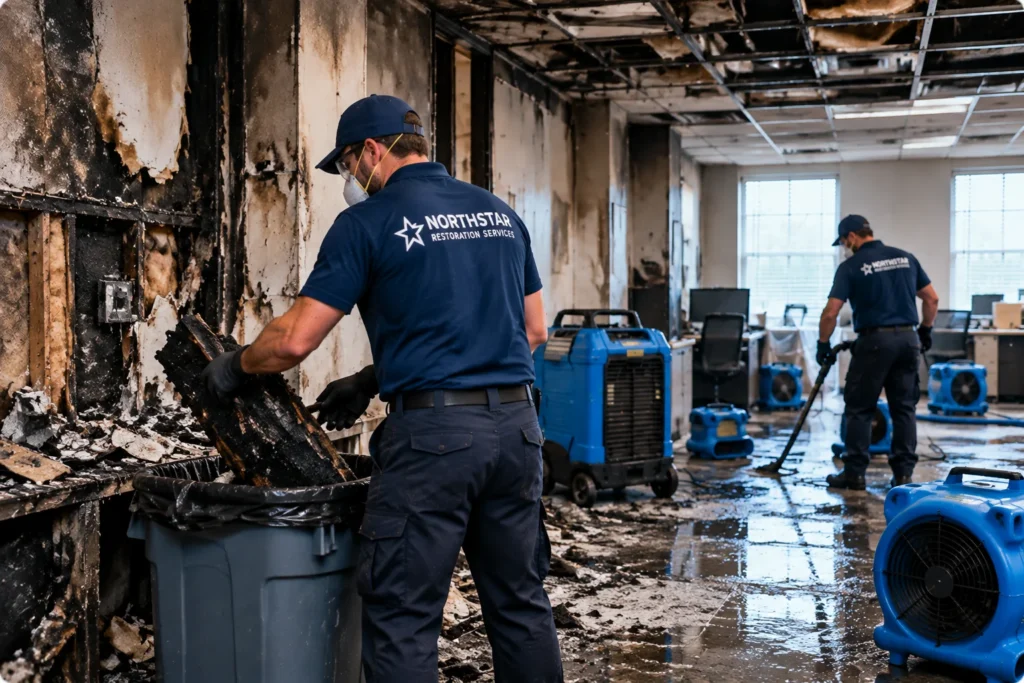
The first objective is not to rush into cosmetic repairs. It is to understand the affected areas, coordinate with the appropriate authorities, secure the property, document the loss, control water and residue spread, determine what can be restored, and build a clear path back to operation.
A professional response can extend from emergency stabilization through cleaning and repair, depending on the loss. The ANSI/IICRC S700 standard addresses assessment of fire residues and odors affecting buildings, HVAC systems, and contents, as well as restoration work planning, documentation, cleaning, and odor management.
For an owner searching for commercial fire damage restoration near me, the useful question is not simply who can arrive with cleaning equipment. Ask who can explain the fire-affected zones, smoke pathways, water impact, contents priorities, security needs, documentation process, and the handoff from mitigation to repair.
A typical scope can include emergency assessment, debris removal, temporary protection, water extraction where required, residue evaluation, soot cleanup, targeted cleaning, contents handling, odor treatment, selective demolition, and repair. SERVPRO’s current competitor page similarly surfaces board-up, water removal from firefighting efforts, soot/smoke removal, cleaning of restorable items, and commercial large-loss capabilities.
Our Commercial Fire Damage Cleanup Process
A strong Commercial Fire Damage Cleanup plan should be based on the actual building, fire event, residues, water impact, and business priorities rather than a fixed checklist applied to every property.
1. Emergency Contact, Authority Coordination, and Site Priorities
The first call should establish what happened, whether the fire department or another authority has released the affected areas, which utilities may be involved, and who is authorized to make decisions for the business. Do not send employees into an area that has not been cleared for entry. The initial project conversation should also identify critical spaces such as server rooms, inventory areas, production zones, records storage, tenant spaces, pharmacies, kitchens, or customer-facing areas.
An emergency fire response plan should prioritize life safety, building access, asset protection, and operational decisions before routine cleaning begins. The IICRC S700 framework expressly includes coordination with Authorities Having Jurisdiction and documentation within professional restoration planning.
2. Secure Openings and Protect the Property
Fire can leave broken windows, damaged doors, roof openings, or other exposures. When the building envelope is compromised, temporary protection may be necessary to limit weather intrusion and unauthorized access. Depending on the conditions, crews may board up damaged openings and install roof tarping where appropriate. These measures are temporary stabilization steps, not substitutes for permanent repairs.
SERVPRO also makes board-up and roof protection a distinct fire-restoration step, which is a useful competitor benchmark for making stabilization visible near the top of the page.
3. Document Fire, Smoke, Water, and Contents Conditions
A useful assessment should document the location and intensity of visible damage, smoke migration, soot deposition, affected building systems, wet materials, and contents. Good insurance claim documentation can include photographs, inventories, material notes, moisture readings where water is present, cleaning decisions, removal decisions, equipment records, and repair estimates.
Coverage itself remains subject to the individual policy, endorsements, exclusions, limits, cause of loss, and insurer determination. The current NorthStar page’s wording that “most” policies cover specific restoration items should therefore be made more conditional.
4. Address Firefighting Water and Moisture
Water used during suppression can affect floors, walls, ceilings, insulation, contents, and concealed assemblies beyond the visibly burned area. When needed, water removal after fire should occur before or alongside the broader drying plan. NorthStar’s commercial water-removal service should own the detailed extraction intent, while this page explains why suppression water is part of the overall fire-loss assessment. NorthStar already maintains a separate commercial extraction page.
If wet structural materials require continued drying, use documented moisture measurements and an appropriate water-restoration process rather than assuming that surfaces are dry because standing water is gone. IICRC’s S500 is the separate professional standard covering water-damage restoration procedures in commercial and other buildings.
5. Remove Unstable Debris and Evaluate Materials
Charred, loose, or non-restorable material may need controlled removal before detailed cleaning can proceed. The decision to remove or retain a material should consider its physical condition, residue impact, accessibility, cleanability, odor retention, and role in the building assembly. This is where professional fire cleanup differs from simply hauling away visibly burned items.
6. Identify Smoke and Soot Impact
Smoke can move beyond the room where flames occurred and affect ceilings, wall surfaces, structural materials, mechanical systems, and contents. The IICRC S700 framework specifically treats fire residues and odors as conditions that must be assessed for their presence, intensity, and boundaries. That supports a measured scope rather than automatically assuming that every room or every HVAC component requires identical treatment.
When the primary problem is residue and odor outside the fire-damaged zone, NorthStar’s commercial smoke damage service should carry the deeper smoke damage remediation intent. The live smoke page already exists as a distinct service asset, so the two pages should serve different search journeys instead of repeating each other.
7. Clean Surfaces According to Residue and Material
Cleaning methods should be chosen according to the residue, substrate, finish, and restoration goal. Dry particulate residue, oily residue, protein-related contamination, painted surfaces, masonry, metal, glass, textiles, and electronics may require different procedures. A page should not claim that one chemical, abrasive method, or deodorizing technology is universally appropriate.
The objective of commercial fire restoration is to use an appropriate effective method while documenting when replacement is more reasonable than cleaning. IICRC S700 addresses practical methods, equipment, tools, materials, cleaning, and fire-odor management rather than prescribing one universal treatment.
8. Evaluate Contents and Business Assets
Commercial losses can affect merchandise, furniture, equipment, records, textiles, electronics, tools, and tenant or customer property. Contents cleaning may occur on site or through an organized pack-out process when the item can reasonably be restored. High-value electronics, documents, machinery, regulated materials, and specialized equipment may require qualified specialists beyond general restoration cleaning. A useful inventory process should record what remains on site, what is moved, what is discarded with authorization, and what requires separate evaluation.
SERVPRO’s competitor structure explicitly includes cleaning restorable items and commercial cleaning of textiles and other contents, making this an important decision-stage content gap for NorthStar to cover more clearly.
9. Manage Smoke Odor Based on the Source
Odor treatment should follow residue removal rather than function as a substitute for cleaning. Professional odor removal may combine source cleaning, removal of non-restorable materials, ventilation or filtration strategies, and other methods appropriate to the building and residue conditions. Any fogging, ozone, hydroxyl, sealing, or chemical treatment should be used only when technically appropriate and according to equipment, product, occupancy, and safety requirements.
This is also where deodorization should be explained as a project-specific process, not a guarantee that one machine or product will solve every post-fire odor condition. The current NorthStar page lists thermal fogging, ozone, and hydroxyl treatment in prescriptive terms; the rewrite should make those technologies conditional on the actual restoration work plan.
10. Repair, Rebuild, and Return to Operation
Once affected areas are stabilized, cleaned, dried where necessary, and ready for repair, the project can transition to fire damage repair. Depending on the loss, that may involve drywall, ceilings, flooring, framing, finishes, doors, cabinetry, electrical coordination, mechanical work, painting, and other approved repairs. For larger projects, commercial reconstruction should have a defined scope, schedule, responsibility matrix, and communication plan.
The restoration contractor should distinguish clearly between:
- Emergency stabilization
- Cleaning and mitigation
- Specialty trades
- Reconstruction
- Final handoff
NorthStar’s existing page says its in-house reconstruction scope can continue through structural repairs and interior finishes, so that capability should be presented as a clearly defined later phase rather than blended into every earlier section.
Large Commercial Losses and Operational Continuity
A restaurant fire creates different priorities from a warehouse, hotel, medical office, retail store, school, multifamily building, or manufacturing facility.
Large loss restoration therefore requires more than scaling up the number of technicians. It can require phased access, additional equipment, contents logistics, security coordination, multiple stakeholders, and detailed scheduling.
Ready.gov recommends formal continuity planning around the operational impacts of business disruptions, including identifying time-sensitive functions and recovery priorities.
For a fire loss, those discussions should identify:
- Functions that must resume first
- Areas that can remain closed
- Temporary workspace options
- Customer communications
- Vendor dependencies
- Records and technology priorities
- Employee access
- Reopening criteria
NorthStar’s PREP Planning program is a particularly useful internal resource here. NorthStar describes PREP as a collaboration with commercial and large-loss clients to document infrastructure and priorities before a disaster and support faster operational recovery.
Fire and Smoke Are Related—but the Pages Should Have Different Jobs
NorthStar has separate commercial fire and smoke URLs. They should not become near-duplicate pages. Use this fire page for:
- Flame and heat damage
- Structural/material decisions
- Firefighting water
- Property stabilization
- Contents
- Complete recovery
- Rebuilding
Use the commercial smoke damage cleanup page for:
- Smoke migration
- Residue types
- Odor assessment
- HVAC impact
- Surface-specific cleaning
- Smoke-only events
The current pages overlap heavily in long-form storytelling and complete-restoration explanations, creating a probable cannibalization risk. This is an SEO inference based on the two live pages’ current content.
What About HVAC Systems After a Fire?
HVAC equipment and ductwork may need evaluation when smoke or residues have entered the system, but cleaning should be based on evidence from the actual event.
The IICRC S700 standard explicitly includes building systems such as HVAC within the scope of fire-residue assessment.
That does not mean every commercial fire automatically requires complete duct cleaning.
If system-specific assessment is necessary, document where HVAC smoke contamination is found and define which components are included before work begins.
The current page currently tells owners to insist on thorough HVAC cleaning after any commercial fire and then lists specific methods such as dry-ice blasting and chemical cleaning. That recommendation should be changed from universal to assessment-driven.
How Long Does Commercial Fire Recovery Take?
There is no reliable universal timeline. A contained event with limited material impact may move relatively quickly, while a loss involving structural damage, extensive smoke spread, suppression water, contents, permitting, specialty trades, or supply delays can take considerably longer.
The better approach is milestone-based scheduling:
- Site released and accessible.
- Emergency stabilization completed.
- Assessment and documentation completed.
- Water and unstable materials addressed.
- Cleaning and material decisions completed.
- Repair scope approved.
- Reconstruction completed.
- Final walkthrough and handoff.
This gives a facility manager a more useful roadmap than promising that a particular category of property will reopen within a fixed number of days.
What Determines the Cost?
The cost of Commercial Fire Damage Cleanup depends on the actual loss rather than one square-foot number. Important variables can include:
- Size of the affected area
- Type and intensity of residues
- Structural damage
- Suppression-water impact
- Contents volume
- Required temporary protection
- Access restrictions
- Cleaning methods
- Material removal
- Specialty equipment
- After-hours requirements
- Repair and reconstruction scope
For a large commercial property, the estimate should separate emergency mitigation, cleaning, contents, specialty services, and rebuilding so the owner can understand what each phase includes.
Why Choose NorthStar in Wausau?
NorthStar states that it is based in Wausau, reports more than 100 years of combined experience, lists fire and smoke work among its trained service areas, and displays an IICRC Certified logo on its About page. The strongest E-E-A-T version of this page should add project-level proof rather than rely primarily on “#1,” “expert,” or “top-rated” language.
Useful evidence includes:
- A named project manager
- Verified individual credentials
- Original before-and-after images
- Actual equipment and products
- A real Wausau or Central Wisconsin commercial fire case
- Photos of affected surfaces and completed work
- Documented contents decisions
- A clear repair timeline
- A relevant customer review
Customers can review NorthStar’s About Us page and recent reviews and projects before selecting a provider.
Schedule Commercial Fire Damage Cleanup
If your Wausau-area business has been released for restoration work after a fire, contact NorthStar to define the immediate stabilization, assessment, cleaning, contents, water, and repair priorities. When you call, be ready to provide:
- Property address
- Facility type
- Date and approximate time of the fire
- Fire department or authority status
- Known water impact
- Critical operational areas
- Inventory or equipment concerns
- Insurance contact information
- On-site decision maker
- Access and security requirements
For NorthStar’s broader commercial emergency capabilities, review the Commercial Benefits & Services page. NorthStar presents its commercial program around emergency restoration, professional cleaning, and PREP planning.
Need Emergency Help?
Contact NorthStar after the property has been released for restoration access and provide the basic loss information above. The first restoration conversation should answer:
- What areas are safe to access?
- What must be secured immediately?
- What is affected by water, smoke, soot, or heat?
- What contents are priorities?
- What needs documentation before removal?
- What is the path to reopening?
Frequently Asked Questions About Commercial Fire Damage Cleanup
Follow instructions from the fire department or other authority, keep employees and customers away from areas that have not been cleared, notify the appropriate insurer or risk contact, and arrange a restoration assessment once access is permitted.
Avoid disturbing residue or moving damaged materials simply to begin cleaning faster.
A fire loss may involve burned structural or finish materials, suppression water, openings that need stabilization, damaged contents, smoke, soot, and repair work.
A smoke-only loss may primarily involve residues and odor outside the direct burn area. NorthStar’s separate smoke page should provide the deeper guidance for that condition.
No.
Cleanability depends on the residue, material, finish, heat damage, physical condition, penetration, and restoration objective. Some items respond to professional cleaning while others are more appropriate to replace.
IICRC’s S700 framework specifically addresses assessment and restoration decisions for fire residues affecting structures, systems, and contents.
No.
The system should be evaluated when evidence suggests smoke or residues entered affected components. The scope should be based on the documented boundaries of the loss rather than an automatic whole-system requirement.
Sometimes.
The decision depends on authority restrictions, structural and electrical conditions, residue boundaries, water impact, work-zone separation, equipment, access, and the type of business operation.
Any partial reopening plan should prioritize safety and documented operational requirements.
Coverage varies by policy, cause, endorsements, limits, exclusions, and carrier determination.
The restoration provider can support the process with photographs, inventories, estimates, readings, work records, and other project documents without promising coverage.
Items should be documented and evaluated before disposal when conditions allow.
Some property can be cleaned or restored; other items may require specialty evaluation or replacement. Keep disposition decisions traceable so the owner, insurer, and restoration team understand what happened to each major asset.
The transition occurs after immediate hazards and unstable conditions are addressed, affected materials have been evaluated, necessary cleaning and drying are completed, and the repair scope is defined.
The exact point varies by project and may require coordination with authorities, insurers, consultants, designers, or specialty trades.
Proudly Serving Central Wisconsin
Looking for something else?
Water Damage Cleanup
Residential Water Damage Restoration
Flooding & Water Damage Repair
Your Business Deserves Fire Restoration You Can Trust
A fire in your commercial property represents one of the most challenging experiences a business owner can face. The physical damage is obvious, but the emotional weight—the worry about your employees, your customers, your future—can feel overwhelming. But here’s what I want you to remember as you stand in the aftermath: this moment doesn’t define your business. How you respond to it does. And you don’t have to respond alone.
When you search for commercial fire damage cleanup near me, you’re looking for more than someone with cleaning products and a truck. You’re looking for a partner who understands the stress you’re under, who has the expertise to handle the complexity of fire restoration, and who will guide you through the process with clarity and compassion.
At NorthStar Restoration Services, we combine 24/7 emergency response with certified expertise in fire damage restoration. Our technicians hold triple-master certifications across water, fire, smoke, and textile restoration disciplines. We’ve helped hundreds of businesses across Central Wisconsin recover from fires, and we’re ready to help yours. Don’t let fire damage threaten everything you’ve built. Call the professionals who understand the urgency and have the experience to handle it right. Call us today at (866) 439-9318. We’re standing by 24/7 to respond to your fire emergency.