
NorthStar Restoration Services provides Air Duct Cleaning for homes and businesses in Wausau and across Central Wisconsin. The service is designed for HVAC systems where visible dust, debris, construction residue, contamination after renovation, pest-related material, or other conditions justify professional inspection and cleaning.
The goal should not be to make exaggerated health promises. It is to assess the system, determine whether cleaning is warranted, remove accessible contamination using an appropriate process, protect the property during the work, and document what was serviced.
EPA does not recommend routine duct cleaning simply because a system has reached a certain age. Instead, it recommends considering the service when specific conditions justify it, including substantial visible mold growth in hard-surface ductwork or HVAC components, vermin infestation, or excessive dust and debris that is being released into the home.
NorthStar is based in Wausau and states that its team has more than 100 years of combined restoration experience. Its About page also lists air-duct and dryer-vent work among the services its team is trained and certified to help with.
When Should You Consider Professional Duct Cleaning?
Air Duct Cleaning should be condition-based rather than sold as an automatic every-few-years requirement. A professional duct inspection may make sense when you notice:
- Heavy visible buildup inside accessible ductwork
- Debris coming from supply registers
- Evidence of rodents, insects, or nesting material
- Suspected contamination after construction or remodeling
- Soot or particulate contamination after a fire or smoke event
- Persistent debris following another HVAC or restoration project
- Visible contamination on accessible system components
- A specific problem identified during an HVAC evaluation
EPA advises consumers to be cautious about sweeping claims concerning health benefits and about companies that present routine cleaning as universally necessary. EPA also states that if a contaminated heating and cooling system is cleaned, relevant components should be addressed so an untreated component does not contaminate the system again. If you searched for air duct cleaning near me, ask the contractor what condition was observed, exactly which components are included, what method will be used, and how the work will be verified.
What Should a Complete HVAC Cleaning Scope Include?
A proper scope should be based on the HVAC configuration and the contamination found during inspection. Depending on the system and accessibility, HVAC duct cleaning may include the supply and return ducts, registers, grilles, accessible plenums, and other components identified in the written scope.
EPA describes duct cleaning as potentially involving multiple components of a forced-air heating and cooling system—not merely wiping the visible vent covers. A contractor should explain whether the project includes:
- Supply registers
- Return grilles
- Main trunks
- Branch ductwork
- Accessible plenums
- Blower or fan components when appropriate
- Accessible coils or drain pans when relevant
- Register cleaning and reinstallation
- Post-cleaning inspection
That gives the customer substantially more information than a generic promise to “clean the vents.”
Our Recommended Professional Cleaning Process
A transparent cleaning process helps property owners understand exactly what is happening and reduces the risk of paying for a superficial service.
1. Inspect the System
The technician should begin with a walkthrough of the property and HVAC system.
The evaluation should identify:
- Number of HVAC systems
- Supply registers
- Return openings
- Equipment locations
- Accessible duct sections
- Existing access points
- Visible buildup
- Possible contamination sources
The purpose of this inspection is to establish whether cleaning is actually justified and determine which components belong in the project scope.
2. Protect the Property
Floors, furniture, walls, and nearby finishes should be protected when the planned work could expose them to dust or equipment movement.
Registers and access points should be handled carefully, and the work area should be organized so loosened debris remains controlled.
3. Establish Controlled Collection
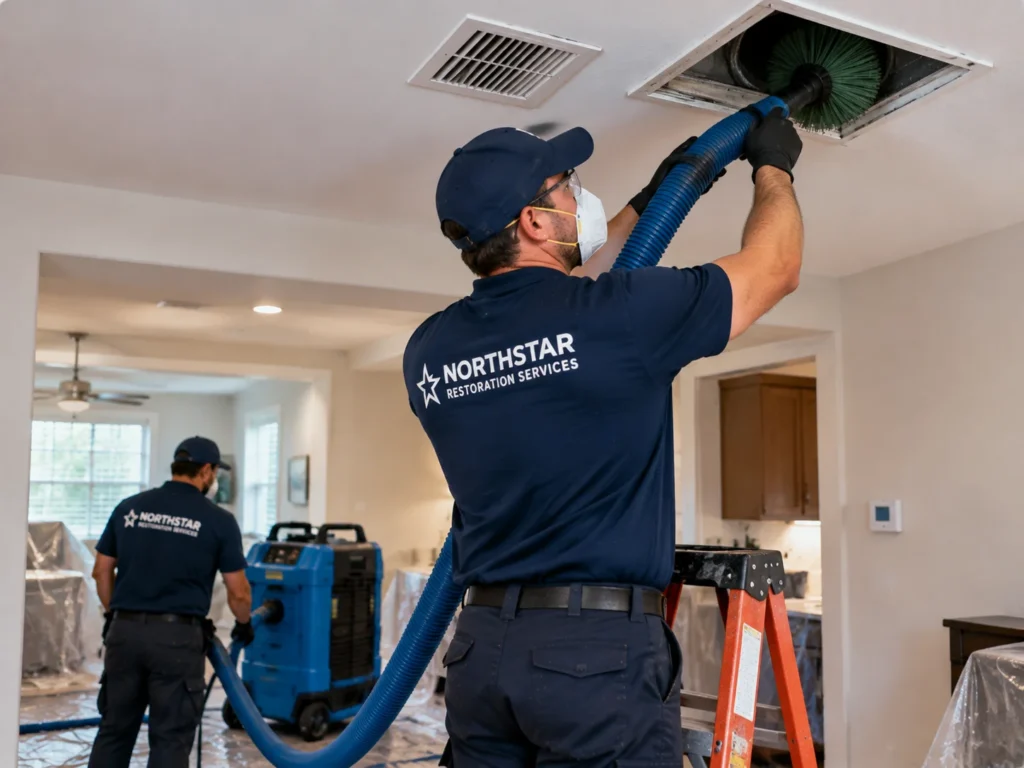
Many professional systems use negative-pressure collection to move loosened material toward collection equipment instead of allowing debris to spread into occupied rooms.
Ductech, for example, describes a process that combines a high-powered HEPA-filtered vacuum with brushes and air whips. COIT describes a negative-pressure system combined with agitation and cleaning of additional HVAC components. Those are useful process benchmarks, but NorthStar should publish only the equipment and procedures its own technicians actually use.
4. Loosen Deposits From Duct Surfaces
Mechanical agitation can help dislodge non-adhered material from interior duct surfaces.
Depending on duct construction and condition, appropriate tools may include:
- Air whips
- Brushes
- Compressed-air tools
- Other mechanical agitation equipment
The industry concept of source-removal cleaning is particularly important: loose contamination should be physically removed rather than merely covered with fragrance or coating.
NADCA identifies assessment, cleaning, restoration, and cleanliness verification as central components of its professional HVAC-system standard.
5. Address Accessible HVAC Components
Cleaning only visible openings can leave contaminated components elsewhere in the system.
EPA specifically warns that failing to clean a contaminated component can lead to re-contamination.
Where included in the scope, air-handler cleaning should take account of equipment design, manufacturer guidance, accessibility, and the conditions found during inspection.
6. Reassemble and Verify the Work
After cleaning:
- Registers should be reinstalled
- Access openings should be properly secured
- Work areas should be cleaned
- The serviced components should be reviewed
Before-and-after photographs can provide useful evidence. Ductech prominently uses photo-documented results, while COIT describes its complete-system process and inspection sequence in detail. NorthStar can compete more effectively by displaying its own Wausau-area projects, actual technicians, equipment, and results.
Residential and Commercial Applications
NorthStar can structure its service for both occupied homes and business properties. Residential duct cleaning may be considered after remodeling, pest activity, visible excessive buildup, a contamination event, or another condition that warrants professional inspection.
Commercial HVAC cleaning can require additional planning around:
- Occupied spaces
- Operating hours
- Multiple HVAC units
- Building access
- Security
- Work-area containment
- Facility-management requirements
For a commercial building, the estimate should identify exactly which systems, units, duct sections, registers, and other components are included.
Does Duct Cleaning Improve the Air Inside a Building?
This question requires a careful answer. Ductwork can contain dust and other material, but EPA states that knowledge about the potential benefits of cleaning remains limited and that duct cleaning has not been demonstrated to prevent health problems generally. EPA also notes that much of the material inside ducts may adhere to surfaces rather than entering occupied rooms.
That means indoor air quality should not be reduced to one cleaning service. Indoor conditions can also be influenced by:
- Source control
- Filtration
- Ventilation
- Humidity and moisture
- HVAC maintenance
- Combustion conditions
- Housekeeping
- Outdoor air
NorthStar should therefore remove current statements suggesting that duct service stops airborne illnesses, cures allergy problems, or produces guaranteed respiratory-health improvements. The stronger E-E-A-T approach is to state exactly what technicians can inspect and remove while directing personal medical questions to qualified healthcare professionals.
Can Cleaning Reduce Energy Costs?
The current NorthStar page states broadly that professional duct cleaning lowers utility bills and extends HVAC-system life. Those claims should be softened unless NorthStar has evidence tied to the specific system being serviced. Cleaning a significantly obstructed component may support airflow verification where an actual restriction exists, but energy consumption depends on many factors, including:
- Equipment condition
- Filter condition
- Duct leakage
- Building envelope
- Thermostat settings
- Insulation
- HVAC sizing
- Outdoor temperature
- Maintenance
Treat HVAC system efficiency as a whole-system issue rather than a guaranteed result from a cleaning appointment.
What If Mold Is Found in the HVAC System?
Visible mold-like growth should be evaluated carefully before treatment begins.
EPA notes that some substances that appear to be mold may require confirmation and that wet or mold-contaminated insulated duct material may need replacement rather than ordinary cleaning.
The source of moisture also needs to be corrected.
Without correcting the moisture problem, contamination can return even after cleaning.
When the condition extends beyond ordinary HVAC maintenance, direct users naturally to NorthStar’s mold remediation service.
Should Sanitizers or Chemicals Be Applied?
Air duct sanitizing should not automatically be added to every project. Consumers should know:
- Which product is proposed
- Why it is being recommended
- Where it will be applied
- Whether its label permits the proposed application
- What ventilation is required
- Whether occupants or pets need to stay out temporarily
- Whether treatment is optional
EPA advises consumers to understand the potential benefits and limitations before permitting biocides or sealants to be applied inside ductwork. Mechanical cleaning and optional chemical treatment should therefore be presented as separate decisions.
Air Ducts and Dryer Vents Are Different Systems
An HVAC distribution system and a clothes-dryer exhaust system perform different functions and have different maintenance concerns.
NorthStar’s dryer exhaust service addresses the lint and airflow pathway from a clothes dryer.
That distinction is important for this competitor analysis because the EA Duct Cleaning URL supplied in the research sheet is a Mountain View dryer-vent landing page rather than a primary air-duct landing page. Its pricing transparency, before/after imagery, FAQs, technician introduction, and conversion design can still be useful UX benchmarks, but its topical content should not dictate this page’s SEO structure.
NorthStar can also internally link to NorthStar’s air-duct and dryer-exhaust guide as a supporting informational resource.
The existing article should support this transactional service page rather than duplicate its full search intent.
How Often Should Ductwork Be Professionally Cleaned?
There is no EPA-recommended universal schedule.
EPA specifically says ducts should be cleaned as needed, rather than simply because a certain number of years have passed.
For that reason, NorthStar should remove the current statement recommending professional cleaning every 3–5 years for everyone.
A better decision framework considers:
- Visible excessive contamination
- Pest activity
- Remodeling or construction residue
- Fire or smoke contamination
- Excessive particulate buildup
- A specific HVAC evaluation
- Other documented reasons for cleaning
This condition-based approach is more trustworthy than a blanket recurring schedule.
What Does Professional Duct Cleaning Cost?
Duct service cost depends on the system and project scope. Common pricing factors include:
- Number of HVAC systems
- Number of supply and return openings
- System layout
- Accessibility
- Amount and type of contamination
- Components included in the scope
- Required access openings
- Residential versus commercial complexity
- Optional treatments
- Unusual site conditions
Avoid publishing one universal price unless NorthStar has a clearly defined package that applies to a specific configuration. Customers can use NorthStar’s Request an Estimate form to provide their property details and concerns. NorthStar’s estimate page is intended for non-emergency service inquiries.
How to Choose a Professional Duct Contractor
When comparing an HVAC cleaning company, process transparency should matter more than broad claims such as “healthiest,” “best,” or “cheapest.”
Ask:
- What condition indicates that cleaning is needed?
- Which HVAC components are included?
- What collection equipment will be used?
- How will loosened debris be contained?
- Will the system be placed under controlled pressure?
- Which agitation tools will be used?
- Are chemicals optional?
- How will the completed work be documented?
- What happens if wet or damaged duct material is discovered?
- What is excluded from the estimate?
Ductech’s strongest competitor advantage is process specificity. Its page describes floor protection, HEPA collection, brushes, air whips, containment, register cleaning, before/after photographs, and airflow-related checks.
COIT similarly describes inspection, truck-mounted collection, negative-pressure cleaning, agitation, plenum work, and accessible air-handler components. NorthStar should match or exceed this level of transparency using its actual process, not generic “advanced equipment” language.
Why Choose NorthStar in Wausau?
NorthStar states that it is based in Wausau, Wisconsin and has more than 100 years of combined restoration experience. Its About page lists air-duct and dryer-vent work among its trained and certified service areas.
Customers can review NorthStar’s company background and credentials and customer reviews before requesting service.
The current reviews page displays 314+ Google reviews and a 4.8/5 rating.
The strongest version of this service page should supplement those business-level trust signals with first-hand evidence specific to duct projects:
- Real technician name
- Actual technician role
- Verified HVAC-cleaning training
- Equipment name/model
- Collection and agitation system
- Original before/after photos
- Wausau-area project example
- Written scope example
- Post-cleaning verification process
Those are assets competitors cannot simply reproduce.
Schedule Air Duct Cleaning in Wausau
If you have a specific reason to inspect your HVAC system—such as visible heavy buildup, pest-related debris, renovation residue, smoke contamination, or another documented concern—NorthStar can evaluate the property and determine whether professional duct service is appropriate.
Use the Request an Estimate form and provide:
- Property type
- Number of HVAC systems
- Approximate number of registers
- Main concern
- Recent construction or remodeling
- Pest history, if relevant
- Fire or smoke history, if relevant
- Photos of visible buildup, when available
A useful estimate should clearly explain what will be cleaned, how it will be cleaned, and how completion will be verified.
Frequently Asked Questions!
No.
EPA does not recommend routine duct cleaning according to a fixed timetable. It recommends considering service when specific conditions justify it.
No professional cleaning contractor should make that medical promise.
A contractor can remove accessible contamination from components included in the project scope, but allergy, asthma, or other medical symptoms should be discussed with a qualified healthcare professional.
The timeframe depends on the number of HVAC systems, number of registers, access, contamination level, system layout, and components included in the project.
NorthStar should provide a scope-specific expectation after inspecting or discussing the system rather than publishing one universal duration.
Professional service should include property protection and a collection method designed to prevent loosened material from spreading throughout occupied areas.
Ask exactly how the contractor will capture and contain debris.
They should be addressed in the written project scope.
EPA recommends treating the relevant contaminated parts of an HVAC system rather than cleaning one isolated component and leaving another contaminated component in place.
No.
EPA states that wet or mold-contaminated insulated duct material may need replacement because it cannot necessarily be cleaned effectively.
The term furnace duct cleaning can mean different things to different customers.
Clarify whether the concern involves:
- Supply ductwork
- Return ductwork
- Registers
- Furnace components
- Air handler
- Exhaust/flue components
These are not interchangeable.
If a customer asks for HEPA-filtered duct service, NorthStar should describe the actual filtration and collection equipment it uses rather than rely on a marketing label.
If NorthStar uses HEPA-filtered collection equipment, publish the actual equipment and process information.
Make HVAC equipment and register areas accessible, secure pets, and tell the team about:
- Recent remodeling
- Pest activity
- Water damage
- Smoke exposure
- Previous chemical treatments
- Known damaged ductwork
Use NorthStar’s online estimate form and explain why you believe the system needs inspection.
A condition-based assessment is more useful than scheduling solely because a certain number of years have passed.